Winged Victory of Samothrace
Paris, France

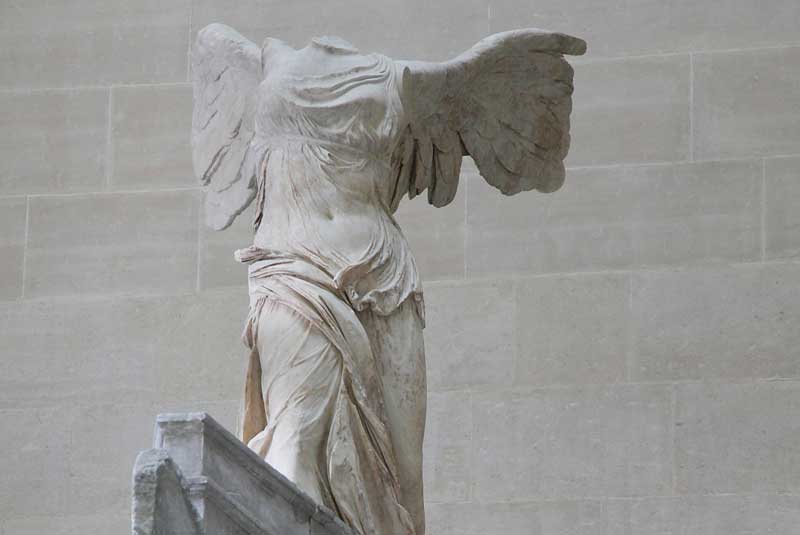
Discover the Winged Victory of Samothrace, a stunning Hellenistic sculpture depicting Nike, the goddess of victory, at the Louvre Museum in Paris, France.
<h2>Overview</h2><p>Perched majestically at the top of the Daru staircase within the world-renowned Louvre Museum in Paris, France, stands the awe-inspiring Winged Victory of Samothrace. This Hellenistic masterpiece, also known as Nike of Samothrace, commands attention with its dramatic pose and powerful sense of movement. Carved from Parian marble, the monumental statue depicts Nike, the Greek goddess of victory, as if she has just alighted upon the prow of a ship, her drapery billowing in the wind. Despite lacking its head and arms, the sculpture remains one of the most celebrated examples of ancient Greek art, drawing millions of visitors each year who come to marvel at its enduring beauty and historical significance.</p><p>Its prominent placement in the Louvre's Denon Wing allows visitors to appreciate its grandeur as they ascend the grand staircase, just as it was originally intended to be viewed in its ancient sanctuary. The Winged Victory is considered one of the Louvre's three greatest female masterpieces, alongside the Venus de Milo and the Mona Lisa, making it an essential stop for anyone exploring the museum's vast collection.</p><h2>History & Cultural Background</h2><p>The Winged Victory of Samothrace dates back to the early 2nd century BC, specifically around 190 BC, placing its creation firmly within the Hellenistic period of ancient Greece. This era was characterized by its expressive sculptures, dynamic compositions, and emotional depth, all qualities vividly embodied by this statue. The sculpture was discovered in fragments in 1863 on the remote Greek island of Samothrace, in the northern Aegean Sea, by French diplomat and amateur archaeologist Charles Champoiseau.</p><p>Originally, the statue was part of a larger complex within the Sanctuary of the Great Gods on Samothrace, a site dedicated to a mystery cult where pilgrims sought protection. It is widely believed that the Winged Victory was created to commemorate a significant naval victory, possibly by the people of Rhodes, over an unnamed enemy. The figure of Nike landing on a ship's prow powerfully symbolized triumph at sea. After its discovery, the numerous fragments were painstakingly transported to Paris and reassembled, eventually taking its celebrated place in the Louvre in the late 19th century.</p><h2>What Makes It Special</h2><p>The sheer technical mastery and artistic vision behind the Winged Victory of Samothrace are what truly set it apart. The sculptor, likely Pythokritos from the School of Rhodes, managed to capture a fleeting moment of movement and triumph in solid marble. The dramatic composition shows Nike with her wings spread wide, her body leaning forward, and her drapery clinging to her form while simultaneously billowing behind her, creating an illusion of wind and motion that is almost unbelievable in stone.</p><p>The statue's ingenious use of 'wet drapery' technique, where the fabric appears transparent and reveals the body beneath, adds a lifelike quality and emphasizes the goddess's form. The choice of materials also contributes to its impact: the figure is carved from fine white Parian marble, while the ship's prow base is made from grey Lartos marble, creating a striking visual contrast. Standing at an impressive 3.28 meters (10.76 feet) tall for the figure alone, and 5.57 meters (18 feet 3 inches) including its base, its monumental scale enhances its commanding presence.</p><h2>Stories, Fun Facts & Local Details</h2><p>While the exact naval battle it commemorates remains a subject of scholarly debate, the statue's purpose as an offering of gratitude for victory is clear. Its original setting within the Sanctuary of the Great Gods suggests it was not merely an artistic display but held profound religious and cultural significance for the ancient Greeks.</p><p>Interestingly, when the fragments of the Winged Victory were first shipped to the Louvre, they were reassembled without the wings and monumental base. It was only later, when archaeologists realized pieces of grey marble found nearby formed a ship's prow, that a second, more comprehensive restoration took place, leading to the iconic form we see today. This second restoration, which included its majestic wings and base, transformed it into one of the Louvre's most popular exhibits. Although missing its head and arms, the statue's emotional power and dynamic stance remain undiminished, testament to the Hellenistic sculptors' ability to convey feeling and action through form.</p><h2>Visitor Perspective</h2><p>Upon entering the Louvre Museum, the journey to the Winged Victory of Samothrace is an experience in itself. Positioned at the pinnacle of the grand Daru staircase, the statue greets visitors with an undeniable force. Many find pausing partway up the staircase offers the best vantage point, allowing the full drama of Nike's descent to unfold before them. As you ascend further, you can walk around the base to appreciate the intricate details of the drapery and the ship's prow from multiple angles.</p><p>The natural light filtering through the nearby windows, combined with the height of its placement, creates shifting shadows across the sculpture, particularly striking in the late afternoon. Photography is permitted, but visitors are encouraged to refrain from using flash to protect the ancient marble. Weekdays might offer a more serene viewing experience, allowing for a more intimate appreciation of this timeless symbol of triumph.</p>
Location
Coordinates: 2.3376, 48.8606
View on Google Maps