The High Altar and Sanctuary
London, United Kingdom

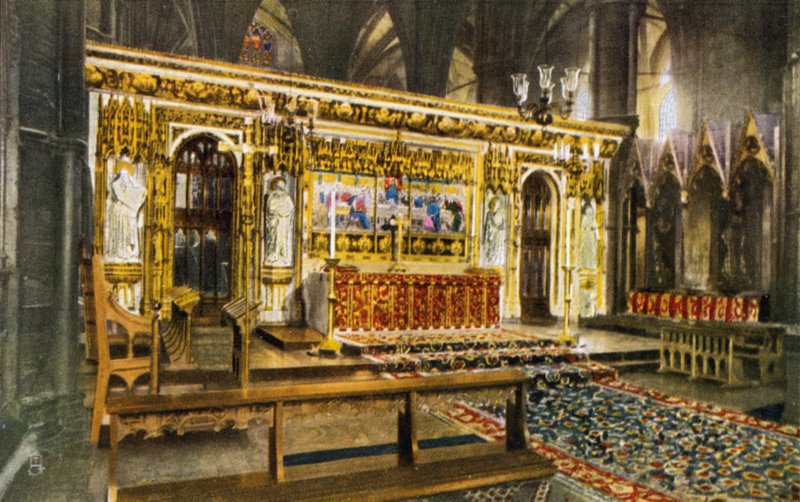
Explore the High Altar and Sanctuary, the spiritual heart of Westminster Abbey, London. Discover its role in royal coronations, its stunning Cosmati pavement, and rich history.
<h2>Overview</h2><p>At the very heart of Westminster Abbey in London, United Kingdom, lies 'The High Altar and Sanctuary', a sub-spot of profound historical and spiritual significance. Also known as the Sacrarium, this sacred area is dedicated to St Peter and serves as the epicenter for the Abbey's most important ceremonies, including the coronations of British monarchs. It is a space where centuries of royal history, religious devotion, and exquisite art converge, offering visitors a tangible connection to the past. The High Altar itself, adorned with a magnificent reredos and a stunning mosaic, stands prominently before the legendary Cosmati pavement, an intricate marble floor that has witnessed countless pivotal moments in British history.</p><h2>History & Cultural Background</h2><p>The history of the High Altar and Sanctuary is inextricably linked with the evolution of Westminster Abbey itself. The original altar was consecrated on 13 October 1269, marking the completion of a significant phase in King Henry III's ambitious rebuilding of Edward the Confessor's Abbey in the Gothic style. Henry III sought to create a grand church that would serve as both a fitting shrine for St Edward and a powerful symbol of royal authority.</p><p>This area's primary cultural significance stems from its role as the traditional site for English and, later, British coronations. Since William the Conqueror in 1066, almost every monarch has been crowned here, solidifying its status as a 'theatre space' designed specifically to host these elaborate ceremonies. The High Altar has also been the setting for numerous royal weddings, including that of Prince William in 2011.</p><p>While the Abbey has undergone many changes over the centuries, the core importance of this sacred space has endured. The current wooden altar table and the elaborate reredos (the screen behind the altar) were designed by the Abbey Surveyor Sir George Gilbert Scott in 1866-67, replacing earlier iterations and ensuring its continued grandeur.</p><h2>What Makes It Special</h2><p>The High Altar and Sanctuary is a synthesis of spiritual reverence and artistic splendor. Dominating the space is the present High Altar and its reredos. This magnificent screen features a mosaic depicting 'The Last Supper', designed by J.R. Clayton and executed by Antonio Salviati, flanked by four large statues of Moses, St Peter, St Paul, and King David, sculpted by H.H. Armstead. Above the mosaic, a gilded frieze illustrates scenes from the life of Christ, adding layers of biblical narrative to the focal point of worship.</p><p>However, what truly distinguishes the Sanctuary is the extraordinary Cosmati pavement directly in front of the altar. Laid in 1268, this intricate marble mosaic is a masterpiece of medieval craftsmanship, featuring geometric patterns composed of thousands of small, precisely cut pieces of colored marble, onyx, porphyry, serpentine, and even colored glass. It is one of the finest examples of Cosmati work north of the Alps and an integral part of the coronation ceremony, literally underpinning the sacred moment of crowning.</p><p>The entire area, often referred to as the Sacrarium, was purposefully designed to create a sense of awe and reverence, drawing the eye towards the altar and the spiritual rituals performed there. Its architectural details and sacred purpose make it a uniquely powerful space within the Abbey.</p><h2>Stories, Fun Facts & Local Details</h2><p>The High Altar and Sanctuary hold many fascinating stories and details. The inscription along the top of the reredos, 'The kingdoms of this world are become the kingdoms of our Lord and of his Christ,' drawn from the book of Revelation, serves as a constant theological declaration within this place of royal power. Adding to the mystique, one of the three Latin inscriptions embedded in the Cosmati pavement famously calculates that the world would last for 19,683 years, a medieval prognostication that continues to intrigue.</p><p>Behind the High Altar lies the Shrine of St Edward the Confessor, the Anglo-Saxon king whose vision led to the founding of the Abbey. Many medieval monarchs chose to be buried near his shrine, emphasizing the enduring connection between royalty and this sacred site. Even the smaller details tell tales: the two candlesticks on the altar table were purchased with money bequeathed by Sarah Hughes, a serving maid who worked for one of the Abbey's clergymen in the 17th century, a testament to the diverse lives connected to this grand institution. The silver gilt cross was a gift from Lord Rosebery in 1899, following his daughter's wedding in the Abbey.</p><h2>Visitor Perspective</h2><p>To stand within the High Altar and Sanctuary of Westminster Abbey is to immerse oneself in centuries of continuous history and faith. As a visitor, you are in the very spot where kings and queens have been crowned, where prayers have been offered for nearly a millennium, and where significant national events have unfolded.</p><p>The architectural grandeur, the gleaming mosaic of the Cosmati pavement, and the intricate details of the altar create an atmosphere of profound solemnity and beauty. While the Cosmati pavement was historically covered to protect it, recent conservation efforts have allowed for its occasional display, offering visitors a rare opportunity to tread upon the same ancient stones as monarchs have for centuries (often with the request to remove shoes to preserve its delicate surface). Even if viewed from a distance, the High Altar and Sanctuary stand as a powerful symbol of heritage, faith, and the enduring legacy of the British monarchy, an unmissable highlight of any visit to Westminster Abbey.</p>
Location
Coordinates: -0.127465, 51.49939
View on Google Maps