Mihrab and Minbar
Istanbul, Turkey

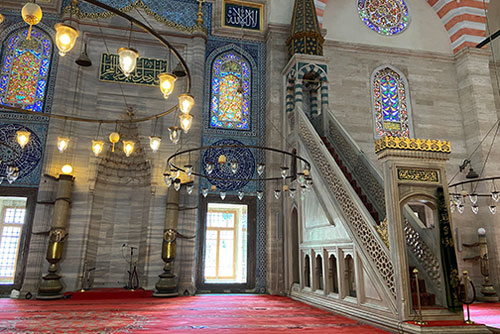
Explore the exquisite Mihrab and Minbar of Süleymaniye Mosque in Istanbul, Turkey. Discover their history, spiritual significance, and stunning Ottoman artistry.
<h2>Overview</h2><p>Nestled within the grandeur of Istanbul's iconic Süleymaniye Mosque, the Mihrab and Minbar stand as central pillars of its spiritual and architectural majesty. These two essential elements, meticulously crafted from pristine white marble and adorned with intricate gold gilding, are not merely decorative features. They represent the heart of Muslim prayer and sermon delivery, guiding the faithful towards Mecca and embodying centuries of Islamic tradition. As you step into the vast, luminous prayer hall, your gaze is naturally drawn to these focal points, which eloquently articulate the mosque's sacred purpose and its profound historical lineage. They are a testament to the Ottoman Empire's artistic prowess and Mimar Sinan's architectural genius, inviting quiet contemplation and admiration.</p><h2>History & Cultural Background</h2><p>The Süleymaniye Mosque, commissioned by Sultan Süleyman the Magnificent and designed by the celebrated architect Mimar Sinan, was constructed between 1550 and 1557. It emerged during the golden age of the Ottoman Empire, intended to symbolize the Sultan's immense power and religious legitimacy. The mosque complex, or külliye, was a sprawling enterprise, featuring madrasas, a hospital, and a public kitchen, reflecting a holistic approach to societal welfare.</p><p>Within this magnificent structure, the Mihrab and Minbar carry a rich history extending far beyond the mosque's construction. The mihrab, a niche indicating the qibla – the direction of the Kaaba in Mecca – is a fundamental element in mosque architecture. While a simple demarcation for prayer direction existed from early Islam, the ornate, recessed mihrab as we know it today developed during the Umayyad period. Similarly, the minbar, the pulpit from which the imam delivers sermons (khutbah), has roots dating back to Prophet Muhammad's time, though it evolved from a simple stepped seat into the more elaborate structures seen in later mosques. It became a powerful symbol of authority for imams and caliphs alike.</p><h2>What Makes It Special</h2><p>The Mihrab and Minbar of the Süleymaniye Mosque are celebrated for their exquisite craftsmanship and material opulence. Fashioned from pure white marble, both are intricately carved with 'stalactites' (muqarnas), a form of ornamental vaulting that creates a cascading, three-dimensional effect, further enhanced by delicate gold gilding.</p><p>The mihrab, in particular, is framed by striking calligraphic panels, featuring large rosettes of glazed tiles. These tiles, with their white Arabic script set against a royal blue background and bordered by turquoise foliage, present sacred verses from the Qur'an. This combination of fine marble, intricate carving, precious gilding, and calligraphic artistry elevates these functional elements into true works of art. The Mihrab's monumental scale, with its niche measuring eight meters in height and width, also contributes to its imposing presence.</p><h2>Stories, Fun Facts & Local Details</h2><ul><li><strong>Sultan's Vision:</strong> Legend has it that Sultan Süleyman the Magnificent himself chose a sample of the most precious porphyry stone to be placed before the mihrab, underscoring the spiritual significance of this area in the mosque.</li><li><strong>Artistic Collaboration:</strong> The intricate tilework and calligraphy found around the mihrab are attributed to master craftsmen of the time, including the famed calligrapher Hasan Çelebi, whose work brought spiritual texts to life with unparalleled beauty.</li><li><strong>Symbol of Power:</strong> The minbar, beyond its religious function, served as a tangible symbol of the Sultan's authority and his role as the protector of Islam, reinforcing the idea of Süleyman as a 'Second Solomon.'</li><li><strong>Architectural Harmony:</strong> Mimar Sinan designed the mosque with perfect harmony and balance, and the Mihrab and Minbar are integral to this design, drawing the eye and grounding the vast prayer hall.</li></ul><h2>Visitor Perspective</h2><p>Visiting the Mihrab and Minbar within the Süleymaniye Mosque offers a uniquely profound experience. As you approach, the sheer scale of the mosque gives way to the intimate detail of these sacred objects. The soft light filtering through stained-glass windows illuminates the marble, making the gilded carvings shimmer and the blue and white tiles glow. The atmosphere is one of serene devotion, a stark contrast to the bustling city outside. Guests are encouraged to observe quietly, respecting the ongoing prayers. Remember to dress modestly, with women needing a headscarf, and avoid visiting during designated prayer times to fully appreciate the tranquility and historical weight of this remarkable space. It is an opportunity not just to witness architectural marvels, but to feel the echoes of centuries of faith and artistry.</p>
Location
Coordinates: 28.9664, 41.015
View on Google Maps