Süleymaniye Mosque
Istanbul, Turkey

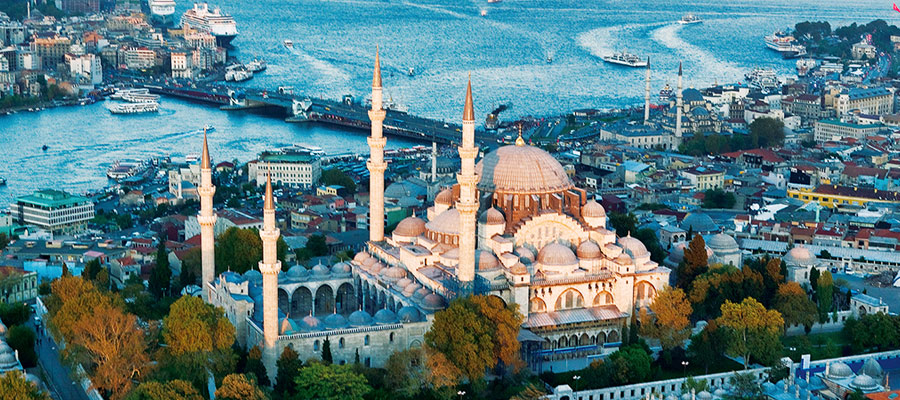
Explore Istanbul's Süleymaniye Mosque, an Ottoman masterpiece and UNESCO site offering rich history, stunning architecture, and panoramic views.
<h2>Overview</h2><p>Perched majestically on Istanbul's Third Hill, the Süleymaniye Mosque stands as an enduring symbol of Ottoman grandeur, offering breathtaking panoramic views of the Golden Horn and the city's historic skyline. This architectural marvel was commissioned by one of the Ottoman Empire's most influential rulers, Sultan Suleiman the Magnificent, during his reign from 1520 to 1566. Designed by the legendary imperial architect Mimar Sinan, its construction began in 1550 and was officially inaugurated in 1557, though some elements of its expansive complex continued to be worked on for a few more years. Widely regarded as a masterpiece of Ottoman architecture and one of Mimar Sinan's greatest achievements, it holds the distinction of being the largest Ottoman-era mosque in Istanbul. More than just a place of worship, the Süleymaniye is the heart of a vast *külliye*, a comprehensive religious and charitable complex, and is recognized as a UNESCO World Heritage Site as part of the 'Historic Areas of Istanbul'.</p><h2>History & Cultural Background</h2><p>Sultan Suleiman the Magnificent envisioned the Süleymaniye Mosque not merely as a place for prayer, but as a testament to the pre-eminence and power of the Ottoman Empire, and even as a grand rival to the Byzantine-era Hagia Sophia. To bring this vision to life, he entrusted the project to Mimar Sinan, who served as chief imperial architect for nearly 50 years. Sinan, originally a stone mason and carpenter, was recruited into the Janissary corps and converted to Islam, receiving extensive training that allowed him to synthesize diverse architectural traditions including Byzantine, Persian, Arab, and Roman styles. The mosque complex was an immense undertaking, drawing skilled workers from across the empire. The *külliye* was designed to serve the community comprehensively, featuring four madrasas (Islamic schools), a medical school, a hospital (darüşşifa), a public kitchen (imaret), a primary school, a guesthouse, baths, and various shops. This integrated complex famously provided a welfare system that reportedly fed over 1,000 poor individuals daily, irrespective of their faith. Over centuries, the mosque has endured significant challenges. It suffered damage in the great fire of 1660 and was subsequently restored by Sultan Mehmed IV. A powerful earthquake in 1766 caused a portion of its dome to collapse. While later repairs in the 19th century introduced Baroque elements that altered Sinan's original decorations, extensive and careful restorations in 1956 and again between 2007 and 2010 have largely returned the mosque to its original splendor.</p><h2>What Makes It Special</h2><p>The Süleymaniye Mosque exemplifies Mimar Sinan's architectural genius, showcasing a profound understanding of harmony, proportion, and structural innovation. Its central dome, soaring to 53 meters with a diameter of 26.5 meters, is a marvel, pierced by 32 carefully placed openings that flood the interior with a sense of lightness and ample natural illumination. Sinan ingeniously adapted and refined the dome-and-semi-dome design popularized by Hagia Sophia, creating a lighter, more balanced structure optimized for Islamic congregational prayer. The mosque is flanked by four elegant minarets, a traditional feature reserved for mosques commissioned by sultans. Interestingly, these minarets boast a total of ten balconies, which are traditionally said to symbolize Suleiman I as the tenth Sultan of the Ottoman dynasty. Inside, the prayer hall is adorned with exquisite Quranic calligraphy by the renowned calligrapher Hasan Çelebi, complemented by restrained patterns of Iznik tiles, intricate stained-glass windows, and fine details in mother-of-pearl, ivory, and marble. Its strategic hilltop location ensures that its elegant silhouette dominates the skyline and provides visitors with unparalleled views across Istanbul, making it a focal point of the city's visual identity.</p><h2>Stories, Fun Facts & Local Details</h2><p>Beyond its architectural brilliance, the Süleymaniye holds fascinating tales. Sultan Suleiman was so impressed by Mimar Sinan's earlier work on the Şehzade Mosque, built in memory of his deceased son, that he then commissioned Sinan to design his own imperial mosque. The design of the Süleymaniye, with its grandeur and strategic placement, positioned Sultan Suleiman as a successor to the biblical King Solomon, subtly drawing parallels to historical figures of immense wisdom and power. Within the peaceful cemetery behind the mosque's qibla wall lie the octagonal mausoleums of Sultan Suleiman the Magnificent and his beloved wife, Hürrem Sultan, often known as Roxelana. In a testament to his own genius and legacy, Mimar Sinan's more modest tomb is also located within the Süleymaniye complex, near the northeast corner, allowing the master architect to rest alongside his greatest creation and its patron. Remarkably, detailed archival records of the mosque's construction, meticulously accounting for labor wages and material costs between 1548 and 1557, have survived. These ledgers offer invaluable insights into the economy and mobilization efforts of the 16th-century Ottoman Empire, reflecting its immense power and organizational capacity. It is also said that Sinan experimented with blue hues for the dome's decoration before settling on the dominant red, a detail only revealed through modern restoration efforts.</p><h2>Visitor Perspective</h2><p>The Süleymaniye Mosque welcomes visitors daily, offering a tranquil and enriching cultural experience. It typically operates from around 9 am until 6 pm, though hours can extend later in summer. However, as an active place of worship, it closes temporarily during the five daily prayer times, usually for about 30 minutes each, and for a longer period during Friday congregational prayers. There is no entrance fee to visit the mosque, upholding its role as a public place of worship, although donations are gratefully accepted. Visitors are kindly requested to observe a modest dress code: women should cover their legs, arms, and hair (a headscarf is necessary), while men should ensure their legs are covered. Loaner coverings are often available at the entrance if needed. For a truly peaceful experience and to avoid crowds, planning your visit for weekday mornings, especially between Tuesday and Thursday, is highly recommended. The mosque's serene atmosphere, combined with its stunning architecture and sweeping city views, creates a memorable visit. Located in the historic peninsula, it is within reasonable proximity to other major attractions like the Grand Bazaar and Spice Bazaar, though travelers should be prepared for a steep uphill walk if coming from the Spice Market.</p>
Location
Coordinates: 28.96376, 41.016064
View on Google Maps