Historical Plaques and Markers
New York, United States

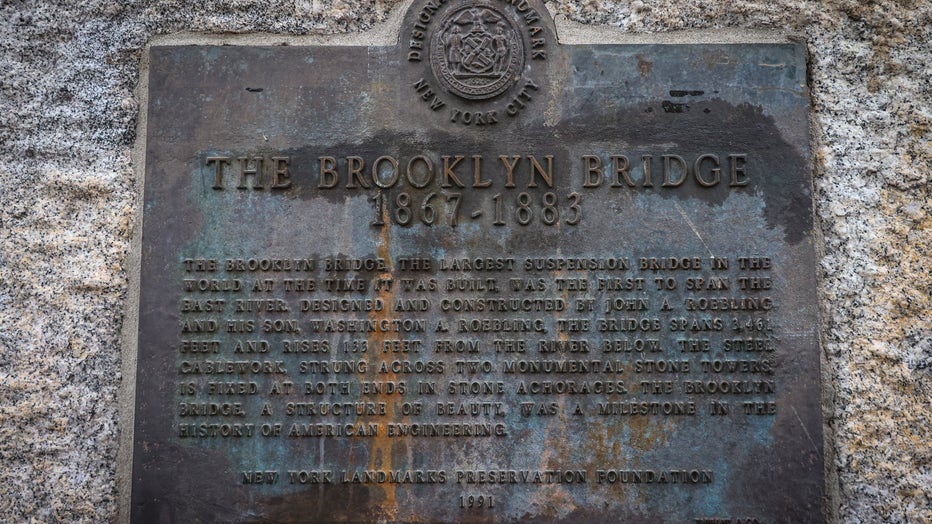
Discover the compelling stories behind the Brooklyn Bridge's historical plaques and markers in New York, United States, honoring its builders and their sacrifices.
<h2>Overview</h2><p>Walking across the Brooklyn Bridge in New York, United States, is more than just traversing a marvel of engineering; it is an immersive journey through a pivotal piece of American history. Amidst the stunning panoramic views of the Manhattan skyline and the East River, visitors will discover a series of historical plaques and markers. These unassuming yet profoundly significant markers serve as silent storytellers, unveiling the human ingenuity, sacrifice, and enduring legacy behind one of the world's most iconic structures. They transform a simple stroll into an educational expedition, inviting curious travelers to pause and connect with the bridge's rich past.</p><p>These plaques are strategically placed along the pedestrian path and at the entrances on both the Manhattan and Brooklyn sides, ensuring that the bridge's narratives are accessible to all who cross. They provide vital construction facts, dedication dates, and highlight the key individuals whose vision and perseverance brought this monumental project to fruition. Far from being mere labels, these markers are portals to the 19th century, offering insights into the colossal effort that bridged two burgeoning cities.</p><h2>History & Cultural Background</h2><p>The story of the Brooklyn Bridge began with the ambitious vision of John A. Roebling, a German immigrant engineer, who proposed the idea of a suspension bridge across the East River in 1857. Construction officially commenced in 1869. Tragically, John A. Roebling suffered a fatal accident during a preliminary survey, succumbing to tetanus shortly after his foot was crushed. His son, Washington A. Roebling, took over as chief engineer.</p><p>Washington Roebling's tenure was also marked by immense personal sacrifice. While working in the pressurized caissons used to build the bridge's foundations, he developed decompression sickness, known as 'the bends,' leaving him severely incapacitated and bedridden. Despite his physical limitations, Washington continued to oversee the project, communicating his instructions through his remarkable wife, Emily Warren Roebling. She became his liaison to the workers and officials, immersing herself in the technical details of engineering, and effectively served as the de facto chief engineer for over a decade. The bridge officially opened on May 24, 1883, becoming the longest suspension bridge in the world at that time. It was designated a National Historic Landmark in 1964 and a National Historic Civil Engineering Landmark in 1972.</p><h2>What Makes It Special</h2><p>What makes the Brooklyn Bridge's historical plaques and markers truly special is their ability to humanize an otherwise colossal feat of engineering. They are not just informative signs; they are tributes etched in bronze, celebrating the unwavering spirit and sacrifices of its creators. Foremost among these is the plaque dedicated to Emily Warren Roebling. This marker specifically honors her pivotal role, acknowledging her faith and courage in helping her stricken husband complete the bridge. It powerfully reminds visitors that behind every great work, there is often the self-sacrificing devotion of a woman.</p><p>Beyond celebrating individuals, other plaques certify the Brooklyn Bridge's status as a New York City designated landmark and a National Historic Civil Engineering Landmark, recognizing its profound impact on urban development and engineering innovation. These markers highlight the bridge's groundbreaking design, combining elements of cable-stayed and suspension bridges, and its use of steel-wire construction, a pioneering technique for its era.</p><h2>Stories, Fun Facts & Local Details</h2><p>The story of Emily Warren Roebling's involvement is perhaps the most compelling tale encapsulated by the bridge's markers. With her husband debilitated by illness, Emily not only conveyed his complex engineering directives but also developed a profound understanding of structural mechanics, stress analysis, and cable construction. She effectively managed day-to-day operations, dealt with politicians, and even represented her husband at official functions, earning the admiration of the assistant engineers. Many believed she was the true mastermind behind the bridge's design.</p><p>A fun fact often shared is that Emily Warren Roebling was, by many accounts, the first person to officially cross the completed bridge, riding in a carriage with a rooster—a symbol of victory. This act was a fitting tribute to her decade-long dedication. Another plaque memorializes the Roebling family, including John A. Roebling, who literally gave his life for the bridge, and Washington A. Roebling, who suffered debilitating illness. These plaques serve as poignant reminders of the immense personal cost behind the bridge's construction.</p><h2>Visitor Perspective</h2><p>For the modern traveler, encountering these historical plaques offers an enriched and deeply personal perspective on the Brooklyn Bridge. They invite contemplation, transforming a casual walk into a reflective experience. Reading the inscriptions provides context to the monumental towers and intricate cable work, allowing visitors to appreciate not just the aesthetic beauty but also the human struggle and triumph embedded within its very structure.</p><p>Tourists often pause to read the plaques, making them an educational stop, especially for families and school groups seeking to understand the bridge's significance beyond its visual appeal. By stopping to read these markers, visitors partake in a quiet act of remembrance, honoring the visionary engineers, the dedicated workers, and particularly the indomitable Emily Warren Roebling, whose contributions might otherwise remain unsung. They ensure that the human drama of the Brooklyn Bridge continues to resonate with every person who crosses its historic span.</p>
Location
Coordinates: -73.997002, 40.706001
View on Google Maps