Cave of Thawr
Mecca, Saudi Arabia

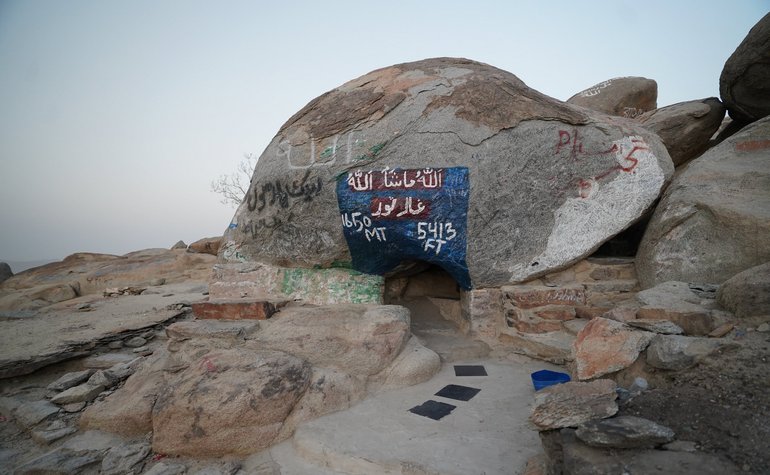
Discover the Cave of Thawr in Mecca, Saudi Arabia. Explore its history as Prophet Muhammad's refuge during Hijrah, a symbol of faith and divine protection.
<h2>Overview</h2><p>Nestled within the rugged landscape of Mount Thawr, approximately four to twelve kilometers south of Masjid al-Haram in Mecca, Saudi Arabia, lies the revered Cave of Thawr, also known as Ghar Thawr or Ghar e Soor. This humble geological formation holds immense significance in Islamic history, serving as a silent witness to a pivotal moment during the Hijrah, the migration of Prophet Muhammad (peace be upon him) from Mecca to Medina. It is a destination that draws pilgrims and curious travelers alike, offering a profound connection to the early days of Islam and lessons in faith, perseverance, and divine protection.</p><h2>History & Cultural Background</h2><p>The story of the Cave of Thawr is intrinsically linked to the early struggles of Islam. In 622 CE, as the Quraysh tribe in Mecca plotted against Prophet Muhammad (peace be upon him), he received divine instruction to migrate to Medina. Accompanied by his devoted companion, Abu Bakr al-Siddiq (may Allah be pleased with him), the Prophet embarked on this perilous journey. Instead of heading directly north towards Medina, they strategically took a southern route and sought refuge in the Cave of Thawr for three nights.</p><p>During these three days, the Quraysh launched an intense search, placing a substantial bounty on the Prophet's head. The search parties scoured the mountains surrounding Mecca, coming perilously close to the cave's entrance. It was during this tense period that the famous Quranic verse was revealed to Prophet Muhammad (peace be upon him), as he comforted a worried Abu Bakr: 'Do not grieve; indeed, Allah is with us.' This moment, immortalized in Surah At-Tawbah (9:40), underscores the profound trust in Allah's protection and companionship.</p><h2>What Makes It Special</h2><p>The Cave of Thawr is celebrated not just for its historical context but also for the miraculous events that unfolded within and around it, demonstrating divine intervention. As the Quraysh search parties approached, a spider remarkably spun a web across the cave's entrance, while pigeons made a nest and laid eggs nearby. This natural camouflage created the illusion that the cave was undisturbed and had not been recently entered, thus deceiving the pursuers and deterring them from investigating further.</p><p>Another poignant detail involves Abu Bakr's unwavering loyalty and self-sacrifice. Before the Prophet (peace be upon him) entered the cave, Abu Bakr meticulously checked and cleaned its interior, blocking all visible holes with pieces of cloth. He overlooked one small opening, which he then covered with his own foot. While the Prophet (peace be upon him) rested with his head on Abu Bakr's lap, a snake emerged from that uncovered hole and bit Abu Bakr. Despite the immense pain, he remained silent, fearing he would disturb the sleeping Prophet. When tears eventually fell from his eyes onto the Prophet's face, Prophet Muhammad (peace be upon him) awoke and, upon learning of the snakebite, miraculously healed the wound with his blessed saliva. This act profoundly exemplifies Abu Bakr's deep love and sacrifice for the Prophet (peace be upon him).</p><p>Physically, the cave is modest, measuring approximately 1.25 meters in height, 3.5 meters in length, and 3.5 meters in width. It features two openings, with the western one believed to be the entrance used by the Prophet (peace be upon him) and Abu Bakr. Its narrow access often requires visitors to crawl to enter, adding to the feeling of humility and reverence.</p><h2>Stories, Fun Facts & Local Details</h2><p>Beyond the primary miracle, the stay in the Cave of Thawr involved a network of support that highlights the dedication of the early Muslim community. Each night, Abu Bakr's son, Abdullah, would discreetly visit the cave. During the day, he would mingle in Mecca, gathering intelligence on the Quraysh's movements and plans, which he would then relay to the Prophet (peace be upon him) and his father under the cover of darkness.</p><p>Furthermore, Amir ibn Fuhayrah, Abu Bakr's freed slave, played a crucial role. He would bring his flock of sheep near the cave each evening, allowing the Prophet (peace be upon him) and Abu Bakr to drink fresh milk, while also cleverly erasing their tracks and Abdullah's tracks from the day with the sheep's hoofprints. These coordinated efforts underscore the ingenuity and devotion that characterized this critical period in Islamic history. The mountain itself, Jabal Thawr, is said to derive its name, meaning 'bull,' from its physical resemblance to a bull's back or head.</p><h2>Visitor Perspective</h2><p>Visiting the Cave of Thawr is a pilgrimage that offers a deeply spiritual and reflective experience for many. The ascent to the cave, located near the summit of Mount Thawr, is challenging. The climb involves steep, rocky paths and can take between 1.5 to 2 hours, depending on one's physical fitness. While physically demanding, the journey is considered a rewarding act of devotion for pilgrims, allowing them to follow in the footsteps of the Prophet (peace be upon him) and Abu Bakr.</p><p>Upon reaching the cave, visitors are not only offered a glimpse into a sacred historical refuge but are also treated to panoramic views of the surrounding Meccan landscape. The experience serves as a powerful reminder of the sacrifices made, the unwavering faith, and the divine protection bestowed during the dawn of Islam. It is a place that fosters contemplation on courage, trust in a higher power, and the profound bonds of companionship.</p>
Location
Coordinates: 39.85083, 21.3775
View on Google Maps