Assembly Hall
Hong Kong, China

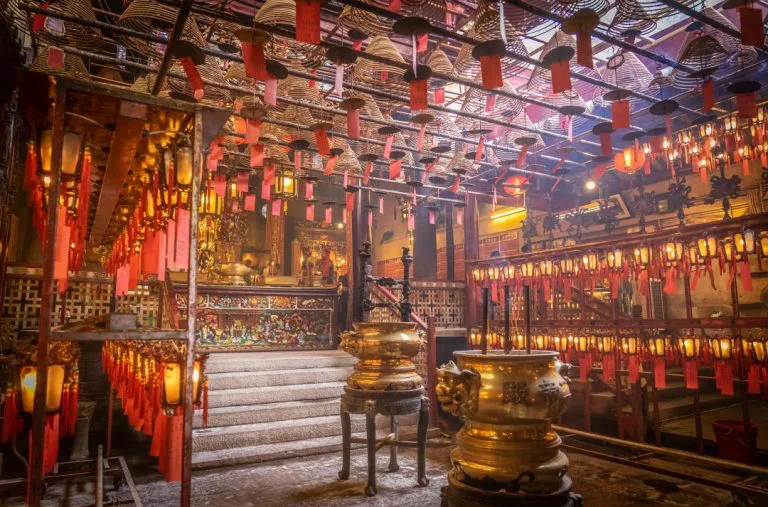
Explore the Assembly Hall (Kung Sor) within Man Mo Temple in Hong Kong, China. Discover its rich history as a community hub and dispute resolution center.
<h2>Overview</h2><p>Nestled amidst the bustling streets of Sheung Wan in Hong Kong, the Man Mo Temple complex stands as a profound testament to the city's rich cultural and historical tapestry. While the main halls are dedicated to the Gods of Literature and Martial Arts, the compound is a collective of three distinct blocks, each serving a unique purpose. Among them is the 'Kung Sor', often referred to as the Assembly Hall. This unassuming yet historically significant structure once served as a vital community hub, where local affairs were discussed and disputes were resolved. Dating back to the mid-19th century, the Assembly Hall, as part of the broader Man Mo Temple complex, holds the esteemed status of a Declared Monument in Hong Kong, preserving its original essence despite the passage of time and numerous renovations.</p><h2>History & Cultural Background</h2><p>The Man Mo Temple compound, including the Assembly Hall (Kung Sor), was constructed between 1847 and 1862 by a group of affluent Chinese merchants. This period marked the early years of British colonial rule in Hong Kong, a time when the nascent legal system was still developing and often inaccessible or culturally unfamiliar to the local Chinese population. Consequently, the temple evolved beyond a mere place of worship, becoming a crucial social and administrative centre. Initially managed by local community leaders, known as 'Kaifong', the temple and its properties were formally entrusted to the Tung Wah Hospital in 1908, an institution that continues its guardianship today. The Assembly Hall, in particular, provided a neutral ground where community issues could be addressed, reflecting the traditional social organization and religious practices that underpinned Chinese society in old Hong Kong.</p><h2>What Makes It Special</h2><p>The Assembly Hall, or Kung Sor, within the Man Mo Temple complex is particularly special due to its pivotal role as a civic and judicial centre during Hong Kong's formative years. It was not merely a meeting place but a venue where local disputes were mediated and settled, often in accordance with traditional Chinese customs rather than British colonial law. This function highlights the ingenuity and self-governance of the Chinese community in adapting to a new colonial administration while maintaining their cultural practices. The presence of the Kung Sor within a temple dedicated to the Civil God (Man Cheong) and the Martial God (Mo Tai) further underscored the integration of spiritual reverence with community governance, where justice was sought not only through human arbitration but also under the watchful eyes of the deities. The hall's preserved historical granite doorframe and other architectural elements offer a tangible connection to this past, providing insight into the community's early legal and social frameworks.</p><h2>Stories, Fun Facts & Local Details</h2><p>Perhaps one of the most fascinating aspects of the Assembly Hall's history revolves around its role in dispute resolution. When formal legal channels were inadequate or mistrusted, locals would bring their disagreements to the Kung Sor. Here, a unique oath-taking ritual was performed to ensure honesty and compliance. Both the plaintiff and defendant would swear an oath before the gods, write their statements (often including a curse or punishment) on yellow paper, and then the paper would be burned after a chicken was sacrificed and its blood dripped onto it. This practice, known as 'Zhan Ji Tou' (chopping off the chicken's head), was considered a powerful and binding commitment, believed to invoke divine retribution if the oath was broken. Such rituals offered a culturally resonant form of justice, deeply rooted in local beliefs and community trust. Beyond disputes, the Kung Sor also played a crucial role in early Chinese education, advocating for and providing free schooling, thus fostering the intellectual growth of the community in Hong Kong.</p><h2>Visitor Perspective</h2><p>Stepping into the Man Mo Temple complex today, including a glimpse into the Assembly Hall's historical significance, offers a unique window into Hong Kong's past, contrasting sharply with the modern skyscrapers that dominate its skyline. While the grand, spiralling incense coils in the main temple halls captivate with their fragrant haze and silent prayers, understanding the Assembly Hall's former function adds another layer of appreciation for this cultural landmark. Visitors are encouraged to explore the compound respectfully, acknowledging its ongoing role as a place of worship and cultural heritage. The Assembly Hall, though perhaps less visually ornate than the main temple, embodies the pragmatic spirit and strong community bonds that characterized early Chinese settlements in Hong Kong. It reminds us that places of worship often served as multidimensional centres, nurturing not just spiritual life but also the social, educational, and judicial needs of their communities.</p>
Location
Coordinates: 114.152621, 22.283242
View on Google Maps