Yivli Minaret
Antalya, Turkey

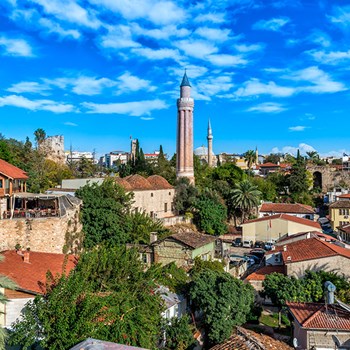
Explore Antalya's iconic Yivli Minaret Mosque in Turkey, a 13th-century Seljuk marvel with its unique fluted minaret and rich history.
<h2>Overview</h2><p>Towering majestically over Antalya's historic Kaleiçi district, the Yivli Minaret is an iconic symbol of the city and a testament to centuries of rich Anatolian history. Often referred to as the 'fluted minaret' due to its distinctive ribbed shaft, this architectural marvel is part of the larger Yivli Minaret Mosque complex. Visible from many vantage points, it beckons curious travelers to explore its unique blend of Seljuk craftsmanship and historical layers. The mosque complex, known as a 'külliye', encompasses several structures beyond the minaret and the mosque itself, including madrasas, tombs, and a dervish lodge, offering a comprehensive glimpse into the cultural evolution of the region.</p><p>Standing approximately 38 meters (125 feet) tall, the minaret is a masterpiece of early Islamic architecture in Anatolia, originally adorned with vibrant turquoise and dark blue tiles that would have shimmered in the Mediterranean sun. Its striking form and historical depth make it an essential stop for anyone seeking to understand Antalya's past and present.</p><h2>History & Cultural Background</h2><p>The origins of the Yivli Minaret and its mosque complex trace back to the 13th century, a significant period following the Seljuk conquest of Antalya in 1226. The minaret itself is believed to have been commissioned by the Seljuk Sultan Alaaddin Keykubad I, who reigned between 1220 and 1237, a ruler known for his extensive patronage of architecture across Anatolia. The original mosque was constructed around 1230, remarkably built upon the foundations or using the walls of a ruined Byzantine church, showcasing a historical continuity of sacred spaces.</p><p>Although the minaret largely retains its 13th-century character, the original mosque prayer hall suffered destruction in the 14th century. It was subsequently rebuilt in 1373 by Mehmet Bey, a member of the Hamidids dynasty, featuring a design with six domes supported by columns that ingeniously incorporated ancient capitals, likely reused from Roman or Byzantine structures. This adaptive reuse of materials highlights the pragmatic and artistic ingenuity of the era's builders. The entire complex has undergone various restorations throughout the centuries, including significant work in the 20th and early 21st centuries, preserving its historical essence for future generations.</p><h2>What Makes It Special</h2><p>The Yivli Minaret stands out as a unique architectural specimen, earning its name 'Yivli'—meaning 'fluted' or 'grooved'—from its distinct eight semi-circular fluted sections. Constructed primarily of red brick, it rises from a robust square stone base, making it an unprecedented design in Anatolian Turkish architecture. What further enhances its special appeal are the remnants of its original dark blue and turquoise tile decorations, which, despite time, still hint at the minaret's former vibrant splendor.</p><p>Beyond the minaret, the Yivli Minaret Mosque itself holds significant architectural importance as one of the earliest and most enduring examples of multi-domed mosques in Anatolia. Its rectangular prayer hall with six domes is a testament to the early Seljuk architectural principles, which often favored simplicity alongside structural innovation. The integration of ancient column heads into the mosque's interior columns provides a fascinating dialogue between different historical periods and architectural traditions, illustrating a blend of cultures that defined Anatolia.</p><h2>Stories, Fun Facts & Local Details</h2><p>The Yivli Minaret is more than just a historical structure; it's deeply woven into the fabric of Antalya's identity. It has become an enduring symbol of the city, frequently appearing in touristic materials and even as part of the logo for Antalya's local football team, Antalyaspor. Imagine the visual spectacle it presented centuries ago when its fluted body was fully adorned with shimmering blue and turquoise tiles, a beacon for travelers arriving by sea into the bustling port of Antalya.</p><p>A fun fact for the adventurous is that the minaret contains an internal spiral staircase with approximately 90 to 92 steps. While it's typically not open to the public for climbing, this detail offers a glimpse into the impressive engineering required for such a tall and ornate structure. The broader complex once housed various community-serving structures, including a Mevlevi lodge (for whirling dervishes) and madrasas, highlighting its role as a vibrant cultural and educational hub in its prime. During a recent restoration, historic water channels were discovered beneath the mosque, which are now visible through a glass floor section, adding another layer of historical intrigue.</p><h2>Visitor Perspective</h2><p>Visiting the Yivli Minaret Mosque offers a profoundly enriching experience for any traveler to Antalya. Located conveniently within the atmospheric winding streets of Kaleiçi, Antalya's old town, it is easily accessible and provides a focal point for exploring the surrounding historical district. As a functioning mosque, it offers a serene and authentic atmosphere. Visitors are welcome, and entrance is typically free, making it an accessible cultural landmark for everyone.</p><p>For those entering the mosque, it's important to remember that it is an active place of worship. Modest attire is required; women should cover their heads, shoulders, and knees, and headscarves are often provided for loan. Men should wear long pants. Photography is generally permitted, but it's crucial to be respectful, particularly during prayer times, and avoid photographing worshippers without permission. The Yivli Minaret and its külliye provide not just a visual spectacle but a tangible connection to Antalya's Seljuk heritage, making it a truly memorable part of your journey through Turkey.</p>
Location
Coordinates: 30.70444, 36.88639
View on Google Maps