The Mosaic of the Virgin and Child
Istanbul, Turkey

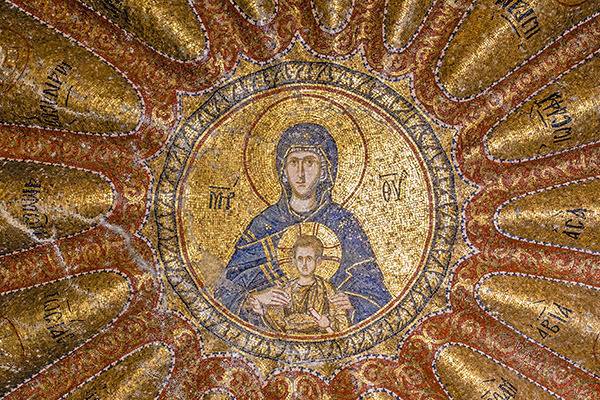
Discover The Mosaic of the Virgin and Child at Chora Church in Istanbul, Turkey. Explore its stunning Byzantine mosaics, rich history, and cultural significance.
<h2>Overview</h2><p>The Chora Church, known today as Kariye Mosque, stands as a breathtaking testament to Byzantine art and history in Istanbul, Turkey. Once a medieval Greek Orthodox church, it boasts some of the most exquisite Late Byzantine mosaics and frescoes in the world, often hailed as masterpieces of the Palaeologian Renaissance. These vibrant artworks, depicting scenes from the lives of Christ and the Virgin Mary, offer a window into a rich cultural and spiritual past. The building's name, 'Chora,' holds a double meaning: it signifies 'country' or 'land,' reflecting its original location outside Constantinople's ancient city walls, and also carries a profound theological interpretation, referring to Christ as the 'Land of the Living' and the Virgin Mary as the 'Container of the Uncontainable'. After centuries as a church, it was converted into a mosque during the Ottoman era, became a museum in the 20th century, and recently reverted to its mosque status, yet its artistic treasures remain preserved for all to behold.</p><h2>History & Cultural Background</h2><p>The origins of the Chora Church can be traced back to the early 4th century, initially built as part of a monastery complex situated beyond the city walls of Constantinople. Throughout its long history, the structure underwent several significant transformations. The majority of the current building dates from the 11th century, a reconstruction initiated by Maria Doukaina, mother-in-law of Emperor Alexios I Komnenos. However, its most renowned period of artistic embellishment occurred in the early 14th century, orchestrated by the wealthy and influential Byzantine statesman and scholar, Theodore Metochites. His patronage led to the creation of the stunning mosaics and frescoes that adorn the interior, marking a flourishing period known as the Palaeologian Renaissance, celebrated for its renewed emphasis on naturalism and emotional expression. Following the Ottoman conquest of Constantinople, the church was converted into a mosque around 1500, known as Kariye Camii. During this time, the Christian imagery was covered with layers of plaster, a practice that, ironically, helped preserve these delicate artworks for centuries. In 1945, it was secularized and designated as a museum, leading to extensive restoration efforts by American scholars that uncovered its original splendor. In 2020, the site was reconverted into a mosque, reopening for worship and visitation in 2024.</p><h2>What Makes It Special</h2><p>What truly sets the Chora Church apart are its breathtaking mosaics and frescoes, considered by many to be among the finest examples of Late Byzantine art. Unlike earlier, more rigid Byzantine depictions, the Chora's artworks are characterized by their profound emotional depth, narrative richness, and dynamic compositions. The artists, whose names remain unknown, employed sophisticated techniques, including nuanced shading and a sense of spatial depth, creating figures that appear almost three-dimensional. The color palette is particularly striking, featuring vibrant golds, deep blues, and rich reds, making the scenes almost glow with an inner light. 'The Mosaic of the Virgin and Child' is a prime example of this artistry, often appearing in various forms throughout the church, such as the 'Meter Theou' (Mother of God) mosaic in the outer narthex, depicting Mary with the infant Christ in her womb, or the 'Virgin Hodegetria' (one who shows the way) in the naos. These depictions are not merely religious icons; they are narratives brought to life, drawing heavily from both canonical and apocryphal texts to tell the detailed stories of Christ and the Virgin Mary. This intricate storytelling, combined with the artistic innovation of the Palaeologian period, elevates Chora to a status comparable to, and in some aspects even surpassing, other famous Byzantine monuments.</p><h2>Stories, Fun Facts & Local Details</h2><p>One of the most compelling stories associated with the Chora Church revolves around its principal patron, Theodore Metochites. A distinguished statesman, scholar, and poet, Metochites poured his personal fortune into renovating and decorating the monastery in the early 14th century. His dedication is immortalized in a mosaic in the inner narthex, where he is depicted kneeling humbly before Christ, offering a model of his magnificently restored church. This self-portrait provides a rare personal touch in Byzantine art, highlighting the bond between patron and sacred space. Another fascinating aspect is how the plaster applied during the Ottoman period inadvertently protected the delicate mosaics and frescoes from the ravages of time and exposure, preserving their vibrant colors and intricate details for later generations to rediscover during the 20th-century restorations. The very name 'Chora' itself is rich in symbolic meaning beyond its geographical origin. Inscriptions within the church creatively interpret 'Chora' not just as a physical place, but as a theological concept. Christ is referred to as 'the Land of the Living' (Η Χώρα των ζώντων), and the Virgin Mary as 'the Container of the Uncontainable' (Η Χώρα του Ἀχωρήτου), ingeniously weaving the monastery's name into a deeper spiritual narrative about incarnation and salvation.</p><h2>Visitor Perspective</h2><p>Visiting the Chora Church, now Kariye Mosque, offers a unique opportunity to immerse oneself in the grandeur of Byzantine artistry. While it is smaller than some other historical sites in Istanbul, the sheer quality and emotional impact of its interior decorations are unparalleled. Travelers often describe feeling a profound connection to the past as they gaze upon the detailed mosaics that narrate biblical stories with such vividness. The experience is like stepping into a 'living Byzantine manuscript,' where every arch and dome tells a story. The 'Mosaic of the Virgin and Child' can evoke a sense of quiet contemplation and wonder, highlighting the tenderness and profound theological role of Mary. Although the building has transitioned back to being a mosque, its historical and artistic value is fully preserved, allowing visitors to appreciate its multi-layered heritage. The journey to the Chora Church, located in the historic Fatih district, takes one through charming, older neighborhoods of Istanbul, offering glimpses of local life away from the city's main tourist hubs, enriching the overall travel experience.</p>
Location
Coordinates: 28.93903, 41.03122
View on Google Maps