The Banker
Cancún, Mexico

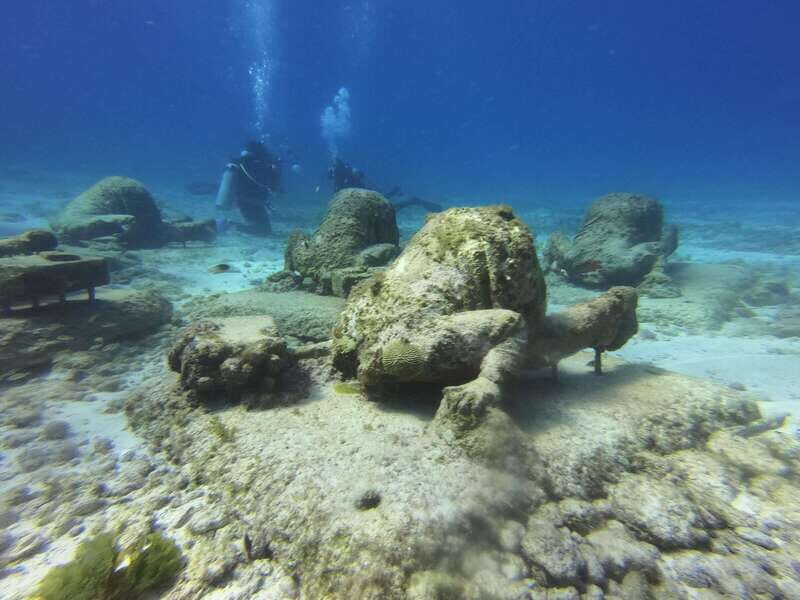
Explore 'The Banker' sculpture at Cancun Underwater Museum, Cancún, Mexico. Discover its environmental message, artistic depth, and role in marine conservation.
<h2>Overview</h2><p>Deep within the azure waters surrounding Cancún, Mexico, lies a captivating underwater art installation known as the Cancún Underwater Museum, or MUSA (Museo Subacuático de Arte). This unique cultural institution combines the beauty of contemporary art with crucial marine conservation efforts. Among its more than 500 submerged sculptures, one particular piece stands out for its potent social commentary: 'The Banker'. Created by the internationally renowned British sculptor Jason deCaires Taylor, 'The Banker' offers a thought-provoking tableau beneath the waves, inviting divers and snorkelers to reflect on pressing global issues.</p><p>Situated within the protected Cancún National Marine Park, MUSA serves a dual purpose: to create artificial reefs that encourage coral growth and marine biodiversity, and to divert tourist traffic away from the region's delicate natural coral reefs, allowing them space to recover. 'The Banker' is located in the Manchones Gallery, one of MUSA's primary exhibition areas, and provides a compelling focal point for visitors exploring this submerged world.</p><h2>History & Cultural Background</h2><p>The genesis of the Cancún Underwater Museum dates back to 2009, born from a visionary collaboration between Jaime González Cano, the Director of the National Marine Park, and Roberto Díaz Abraham, then President of the Cancún Nautical Association. Their objective was clear: the natural reefs were under immense pressure from human activity, and an innovative solution was needed. They sought an artist capable of marrying environmentalism with artistic expression, and found Jason deCaires Taylor, known for his pioneering work in underwater sculpture parks, like the one in Grenada.</p><p>Taylor's approach was revolutionary. His sculptures are crafted from specialized, pH-neutral marine concrete, designed not just to withstand the underwater environment, but to actively promote the growth of coral and other marine life. The first sculptures were deployed in November 2009, and the museum officially opened its gates (or rather, its waters) in November 2010. MUSA has since evolved into a sprawling collection that continues to merge art with ecology, creating a living, breathing exhibition where nature's transformative power becomes an integral part of the artwork itself.</p><h2>What Makes It Special</h2><p>'The Banker' is a powerful artistic statement that distinguishes itself within MUSA's vast collection. The sculpture features six (or initially five, with one separate) life-sized figures of men, each positioned with their heads deeply buried in the sand, while their briefcases rest beside them and their buttocks are conspicuously pointed skyward. This striking posture immediately conveys a sense of willful ignorance and denial.</p><p>Beyond its arresting visual, 'The Banker' is special for its profound symbolism. It serves as a stark critique of economic and political short-sightedness, highlighting how decision-makers often ignore critical environmental degradation and global issues for short-term gain. Made from the same eco-friendly marine concrete as other MUSA sculptures, 'The Banker' is also a testament to regenerative art. Over time, the sculpture becomes colonized by algae and corals, transforming into an integral part of the marine ecosystem. This living transformation emphasizes the very environmental messages the artwork conveys, as marine life literally reclaims and redefines the symbolic figures of denial.</p><h2>Stories, Fun Facts & Local Details</h2><p>The original title for 'The Banker' was reportedly 'The Politicians', underscoring the artist's pointed commentary on leadership and responsibility. The shift in title to 'The Banker' only sharpened its critique, focusing on corporate greed and economic irresponsibility. It's a 'fun fact' that isn't so much fun as it is a somber reflection on human nature.</p><p>Another fascinating detail about 'The Banker' and other MUSA sculptures is their innovative design for marine habitation. Taylor purposefully incorporated cavities and textured surfaces into the sculptures to create micro-habitats for various marine species. For instance, in 'The Banker', king crabs and even eels have been observed making their homes within the crevices, including the space between the figures' buttocks. This integration of marine life adds another layer to the artwork, illustrating how nature reclaims and thrives even amidst symbols of human folly.</p><p>The installation, placed at a depth of about 10 meters (33 feet), is part of the larger 'Silent Evolution' series, which features a vast community of human figures. Each figure, including 'The Banker', contributes to a collective narrative about humanity's complex relationship with the ocean, serving as a reminder that our actions have tangible consequences.</p><h2>Visitor Perspective</h2><p>Experiencing 'The Banker' firsthand is an unforgettable journey into the intersection of art, environmentalism, and underwater exploration. Due to its depth in the Manchones Gallery, 'The Banker' is best appreciated by certified divers. As you descend, the figures emerge from the blue, their posture instantly recognizable and their message resonating with silent power. The calm silence of the underwater world amplifies the impact of the sculpture, creating a meditative and thought-provoking experience.</p><p>For those who may not be certified divers, some snorkeling tours might offer a distant glimpse, but the intricate details and full symbolic weight are truly perceived up close through a dive. Guided tours often include explanations of the sculpture's symbolism, enhancing the educational aspect of the visit. Observing how marine life interacts with and transforms the sculpture provides a tangible connection to MUSA's conservation mission. It’s a powerful reminder of nature's resilience and the urgent need for environmental stewardship, leaving visitors with a lasting impression of art's capacity to inspire change and protect our oceans.</p>
Location
Coordinates: -86.779722, 21.028889
View on Google Maps