The Arch Structure
Paris, France

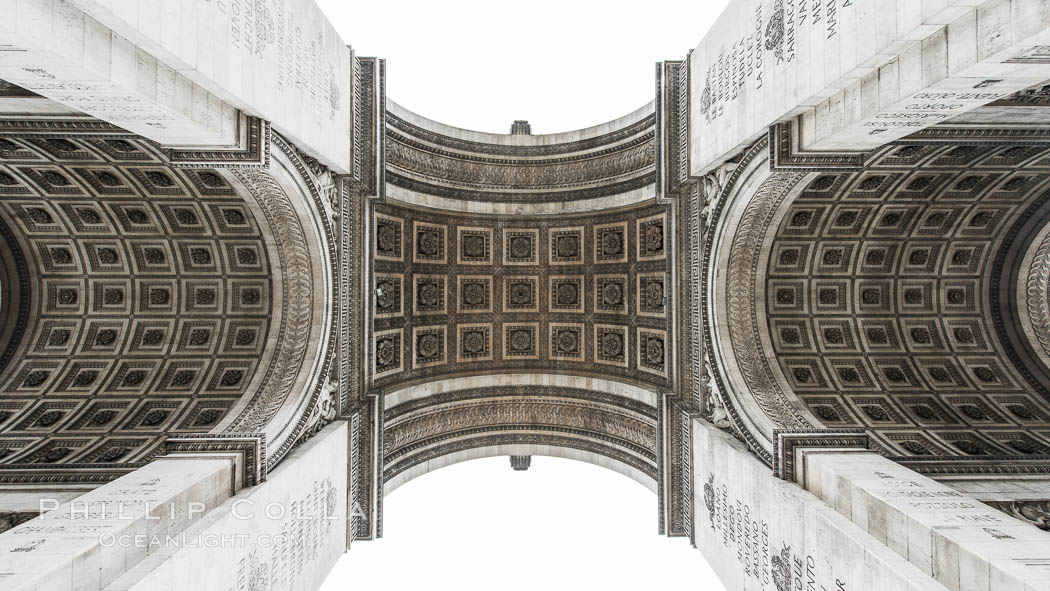
Explore the Arc de Triomphe in Paris, France: a monumental arch honoring French military victories and home to the Tomb of the Unknown Soldier.
<h2>Overview</h2><p>Standing majestically at the western end of the iconic Champs-Élysées, the Arc de Triomphe is one of Paris, France's most renowned monuments. Its full name, Arc de Triomphe de l'Étoile, translates to 'Triumphal Arch of the Star,' referencing the twelve radiating avenues that converge at its base, forming a star-like configuration in Place Charles de Gaulle. This grand structure is not merely an architectural marvel but a profound symbol of French national identity and remembrance. It honors those who fought and died for France, particularly during the French Revolutionary and Napoleonic Wars, with their names inscribed upon its surfaces. It serves as a central point of the 'Axe historique,' a monumental line of buildings and thoroughfares stretching across Paris.</p><h2>History & Cultural Background</h2><p>The history of the Arc de Triomphe is as extensive and grand as the monument itself, spanning over three decades of construction. It was famously commissioned by Emperor Napoleon I in 1806, following his decisive victory at the Battle of Austerlitz. Napoleon's vision was to create a monument celebrating the glory of the French army, particularly during the periods of the Republic and Empire under his leadership. The first stone was laid on August 15, 1806, Napoleon's birthday.</p><p>Designed primarily by Jean-François-Thérèse Chalgrin, the arch's construction was a lengthy endeavor. Chalgrin drew inspiration from ancient Roman arches, notably the Arch of Titus, but scaled his design to an unprecedented size to embody the Napoleonic era's grandeur. However, Napoleon never lived to see its completion, as he died in 1821, and the arch was finally inaugurated in 1836, long after his downfall, during the reign of King Louis-Philippe. Following Chalgrin's death in 1811, several architects, including Jean-Arnaud Raymond and Guillaume-Abel Blouet, oversaw its challenging construction. The monument's purpose evolved over time, becoming a symbol of French patriotism and a tribute to all who have died for France.</p><h2>What Makes It Special</h2><p>The Arc de Triomphe stands out for its colossal scale and intricate sculptural details. Measuring 50 meters (164 feet) tall, 45 meters (148 feet) wide, and 22 meters (72 feet) deep, it was, for a long time, the largest triumphal arch in the world. Its Neoclassical architectural style, characterized by monumental simplicity and classical elements, showcases four major sculptural groups at its base: 'The Departure of the Volunteers of 1792' (La Marseillaise) by François Rude, 'The Triumph of 1810', 'The Resistance of 1814', and 'The Peace of 1815'. The arch's inner and outer surfaces are inscribed with the names of French victories and generals; those names underlined denote individuals who died in combat.</p><p>Beneath the arch's main vault lies the Tomb of the Unknown Soldier from World War I, a poignant and sacred memorial inaugurated on Armistice Day in 1920. An eternal flame, first lit in 1923, burns continuously, symbolizing perpetual remembrance for unidentified fallen soldiers. This solemn feature profoundly changed the monument's significance, transforming it into a revered site of national memory. The panoramic terrace at its summit offers breathtaking 360-degree views of Paris, including the Champs-Élysées, the Louvre, and the Eiffel Tower.</p><h2>Stories, Fun Facts & Local Details</h2><p>Beyond its grand facade, the Arc de Triomphe holds many intriguing stories. Napoleon himself never passed under the completed arch, though a full-sized wooden replica was constructed for his wedding procession in 1810. One of the most famous anecdotes involves French aviator Charles Godefroy, who daringly flew his Nieuport biplane through the arch's main span in 1919 to commemorate the end of World War I. Another fascinating detail is that twice a year, around sunrise on May 8th and sunset on August 1st, the sun aligns perfectly with the arch, framing it in a spectacular golden glow.</p><p>The monument is also a focal point for significant national events. The annual Bastille Day military parade on July 14th traditionally begins at its base, and the Tour de France bicycle race often concludes nearby. Out of respect for the Tomb of the Unknown Soldier, all military processions, including those in times of war like the Nazi occupation and the Allied liberation, have traditionally marched around the arch rather than directly beneath it.</p><h2>Visitor Perspective</h2><p>Visiting the Arc de Triomphe offers a journey through history and stunning Parisian vistas. Access to the monument is via an underground tunnel, the Passage du Souvenir, as attempting to cross the busy traffic circle at ground level is highly discouraged. Once inside, visitors can explore a small museum detailing the arch's history and construction. To reach the panoramic observation deck, one must ascend 284 steps, as there is no elevator for public access to the top. The climb is well worth the effort for the unparalleled views it provides of the city and its radiating avenues. Free access to the Tomb of the Unknown Soldier at the base is available, and the eternal flame is rekindled every evening at 6:30 PM, a moving ceremony to witness. While tickets are required to climb to the rooftop, various concessions are available, including free entry for EU citizens aged 18-25 and visitors under 18.</p>
Location
Coordinates: 2.295028, 48.873792
View on Google Maps