Support A-Frame and Wheel Structure
London, United Kingdom

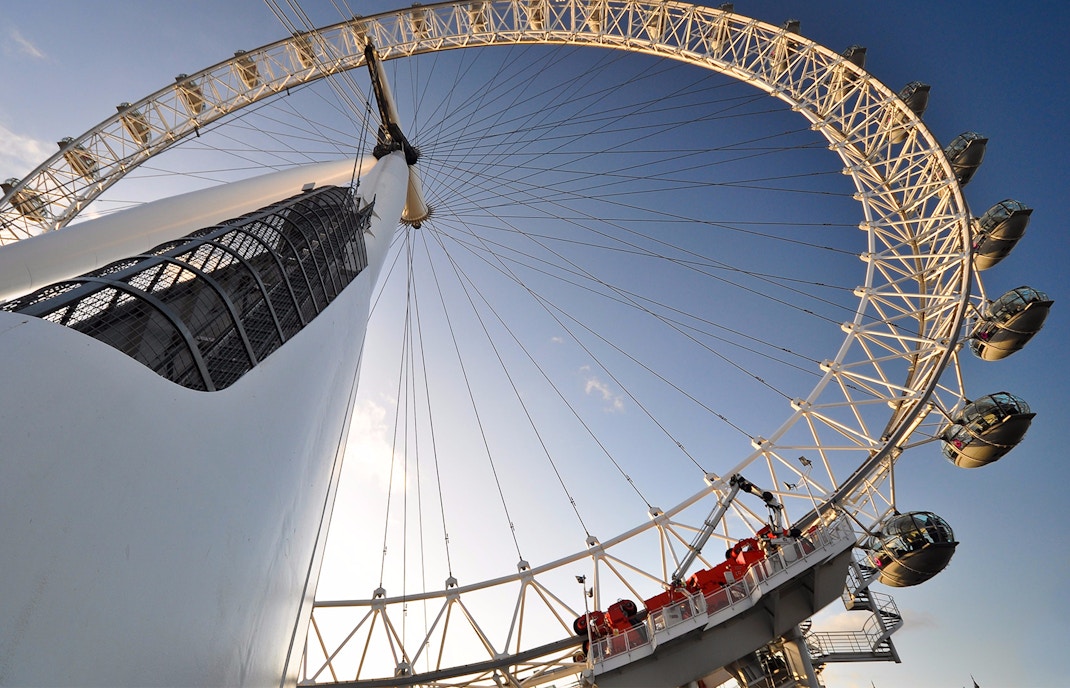
Explore the London Eye's unique A-Frame support and wheel structure, an engineering marvel offering stunning panoramic views of London, United Kingdom.
<h2>Overview</h2><p>The London Eye, officially known as a cantilevered observation wheel, is an undeniable fixture of the London skyline, gracing the South Bank of the River Thames. Its distinctive 'Support A-Frame and Wheel Structure' is what truly sets it apart, making it not just a ride, but a remarkable engineering feat and a celebrated landmark. Unlike traditional Ferris wheels, the London Eye is supported by a single A-frame on one side, allowing the wheel to extend dramatically over the river. This unique design gives it a lighter, more open appearance, reminiscent of a giant bicycle wheel, with its rim supported by a network of tensioned steel cables. Visitors often marvel at the scale and elegance of this structure even before stepping into one of its iconic capsules, which offer unparalleled panoramic views of the city.</p><p>Standing at 135 metres (443 feet) tall with a diameter of 120 metres (394 feet), the London Eye was once the world's tallest Ferris wheel upon its opening in 2000. It remains Europe's tallest cantilevered observation wheel. Its innovative construction allows the 32 passenger capsules to be mounted externally on the wheel's circumference, ensuring unobstructed 360-degree vistas during the approximately 30-minute rotation.</p><h2>History & Cultural Background</h2><p>The London Eye began its journey not as a certainty, but as an ambitious vision. Conceived by husband-and-wife architect team David Marks and Julia Barfield, it was originally an entry for a 1993 competition to design a landmark for the new millennium. Though no official winner was declared, Marks and Barfield pressed on with their bold idea for a giant observation wheel overlooking the Thames.</p><p>Construction commenced in 1998, a massive undertaking that involved an international team of specialists and components sourced from across Europe. The wheel's sections were famously transported by barge along the Thames and assembled horizontally on floating platforms. The painstaking process of raising the immense structure upright, at a rate of just two degrees per hour, captivated public attention. Officially opened on New Year's Eve 1999, it welcomed its first paying passengers in March 2000. Initially, the London Eye was only planned to be a temporary structure, with a five-year planning permission. However, its immediate and overwhelming popularity quickly solidified its status as a permanent and beloved feature of London's cultural landscape. Sir Richard Rogers famously said, 'The Eye has done for London what the Eiffel Tower did for Paris', highlighting its rapid rise as a symbol of the city.</p><h2>What Makes It Special</h2><p>The true marvel of the London Eye lies in its distinctive A-frame and cantilevered structure. Unlike many observation wheels that are supported on both sides, the Eye's wheel is supported solely by a robust A-frame on its eastern bank, projecting the main wheel outwards over the river. This engineering choice is a 'structural rarity for wheels of this scale' and allows for its elegant, open design. The A-frame itself features two large legs, each over 190 feet long and spanning 65 feet at their base, bending at an angle of 65 degrees over the river.</p><p>The wheel's rim, resembling a gigantic spoked bicycle wheel, is not solid but supported by 64 tensioned steel cables radiating from a central hub. These cables are crucial for distributing the wheel's immense weight of approximately 1,600 tonnes. The engineering ingenuity extends to its foundation, which uses 40 piles, each 108 feet deep, to anchor the six cable backstays that prevent the entire A-frame from tilting into the Thames. This intricate balance of tension and compression, along with the precise assembly of its components—including the 32 ovoid capsules mounted externally—showcases a triumph of modern structural expressionism and a blend of form with utility.</p><h2>Stories, Fun Facts & Local Details</h2><ul><li>The London Eye's 32 capsules were designed to represent the 32 boroughs of London. Interestingly, for superstitious reasons, they are numbered 1 to 33, conspicuously omitting the number 13.</li><li>Each capsule weighs 10 tonnes and can hold up to 25 people, allowing visitors to walk around freely during their rotation. The wheel moves at a leisurely pace of 26 centimetres per second, which is approximately twice the speed of a tortoise, ensuring a smooth, gradual experience. This slow speed means it typically doesn't need to stop for passengers to board or disembark.</li><li>The construction involved bringing components from various European countries, including steel from the UK, cables from Italy, capsules from France, and the hub and spindle from the Netherlands, making it a truly European collaboration.</li><li>The London Eye has become an enduring symbol of modern Britain. Its image has been featured in British passports and even in the closing ceremony of the 2012 Summer Olympics. Every New Year's Eve, the wheel becomes the focal point for London's spectacular fireworks display, with thousands of fireworks launched directly from the structure itself.</li><li>The idea of granting public access to elevated views of London was inspired by the architects' daily commutes, noticing the BT Tower and Crystal Palace transmitter.</li></ul><h2>Visitor Perspective</h2><p>Stepping into one of the spacious, glass-enclosed capsules of the London Eye offers a truly transformative experience. The slow, gentle ascent provides a gradual reveal of London's iconic landmarks, from the Houses of Parliament and Big Ben just across the river, to Buckingham Palace, St. Paul's Cathedral, and the Shard further afield. On a clear day, the panoramic views can stretch for up to 25 miles in every direction, reaching as far as Windsor Castle.</p><p>The external mounting of the capsules, a direct result of the unique A-frame and wheel structure, ensures that there are no obstructions between you and the breathtaking cityscape. It's a serene journey that allows for quiet contemplation of London's historical tapestry and bustling modern life simultaneously. Whether it's a first-time visitor or a seasoned local, the perspective offered from above provides a fresh appreciation for the city's grandeur and intricate layout. The very design of its support and wheel structure is integral to this immersive visual narrative, making the London Eye not merely an attraction, but a unique vantage point to connect with the vibrant spirit of London.</p>
Location
Coordinates: -0.119519, 51.503399
View on Google Maps