Statue of Liberty
New York, United States

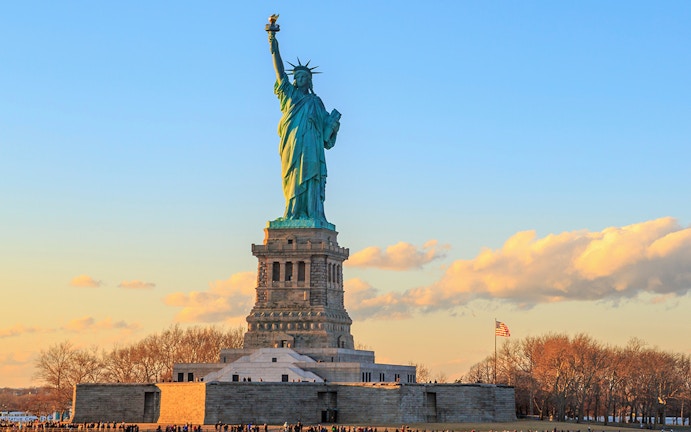
Explore the iconic Statue of Liberty in New York, United States. Discover its rich history, symbolism of freedom and democracy, and unique design.
<h2>Overview</h2><p>The Statue of Liberty, officially named 'Liberty Enlightening the World,' stands majestically on Liberty Island in New York Harbor, New York, United States. This colossal neoclassical sculpture is recognized globally as a universal symbol of freedom and democracy. Millions of visitors each year make the journey to experience her history and grandeur in person, marveling at her enduring significance. She represents a beacon of hope, welcoming people to the United States and embodying the ideals of liberty that the nation upholds.</p><h2>History & Cultural Background</h2><p>The idea for the Statue of Liberty originated in France around 1865, proposed by French political thinker and abolitionist Édouard de Laboulaye. He envisioned a monumental gift from the people of France to the people of the United States to commemorate the centennial of American independence and celebrate the close relationship between the two nations, also acknowledging the abolition of slavery in the U.S. French sculptor Frédéric Auguste Bartholdi was tasked with designing the statue, drawing inspiration from Libertas, the Roman goddess of freedom.</p><p>Construction of the statue took place in France, with Bartholdi overseeing the shaping of approximately 300 copper sheets using the repoussé technique, hammering them onto a hollow wooden form. Gustave Eiffel, renowned for his eponymous tower, designed the innovative internal iron framework, allowing the copper skin to move independently while providing structural stability. The completed statue was presented to the U.S. Ambassador in France in 1884. It was then disassembled into 350 pieces, packed into 214 crates, and shipped across the Atlantic aboard the French frigate 'Isère', arriving in New York Harbor in June 1885. Meanwhile, in the U.S., the pedestal was designed by American architect Richard Morris Hunt and constructed on what was then called Bedloe's Island. The statue was reassembled on its pedestal, and President Grover Cleveland officially dedicated it on October 28, 1886.</p><p>Its significance evolved profoundly in 1903 with the placement of a plaque engraved with Emma Lazarus's sonnet 'The New Colossus' on the pedestal. This poem transformed Lady Liberty into an enduring symbol of welcome and hope for millions of immigrants arriving by sea, seeking new lives in America, especially through nearby Ellis Island.</p><h2>What Makes It Special</h2><p>The Statue of Liberty is a masterpiece of colossal statuary and an engineering marvel. Her design is rich with symbolism: she holds a torch high in her right hand, representing enlightenment and guiding the way for those seeking freedom. In her left hand, she clutches a 'tabula ansata' (tablet) inscribed with 'JULY IV MDCCLXXVI' (July 4, 1776, the date of the U.S. Declaration of Independence). At her feet lies a broken chain and shackle, symbolizing freedom from oppression and the abolition of slavery. Her crown features seven rays, which are believed to represent the seven continents and the seven seas, signifying the universal concept of liberty. The statue's internal framework, engineered by Gustave Eiffel, was a groundbreaking achievement, integrating art and engineering to create a flexible structure capable of withstanding the elements. Designated as a National Monument in 1924, it became a UNESCO World Heritage Site in 1984, recognized for its outstanding universal value.</p><h2>Stories, Fun Facts & Local Details</h2><p>When Lady Liberty was first completed, her copper exterior was a shiny reddish-brown, much like a new penny. Over decades, exposure to the elements caused the copper to oxidize, forming the distinctive green patina seen today. The statue's face is said to have been modeled after Bartholdi's mother. Remarkably, the Statue of Liberty was initially intended to function as a lighthouse, though this proved unsuccessful. She is built to endure the harsh conditions of New York Harbor; 50 mph winds can cause her to sway up to three inches, while her torch can move up to six inches. She is also struck by lightning approximately 600 times each year, though a complex protection system prevents severe damage. The original torch, as envisioned by Bartholdi, was made of solid copper sheets and gilded to shine in daylight. This original torch was later replaced and is now housed in the Statue of Liberty Museum.</p><h2>Visitor Perspective</h2><p>Visiting the Statue of Liberty is an iconic experience, typically involving a ferry ride from Battery Park in Manhattan or Liberty State Park in New Jersey. Visitors can explore the grounds of Liberty Island and access the Statue of Liberty Museum, which offers immersive exhibits and houses the original torch. For those seeking a more intimate experience, tickets are available to access the pedestal or even climb the 162 steps within the statue to reach the crown, offering breathtaking panoramic views of New York Harbor and the Manhattan skyline. Due to high demand, particularly for crown access, tickets should be reserved well in advance through the authorized ferry service, Statue City Cruises.</p>
Location
Coordinates: -74.044502, 40.689247
View on Google Maps