South Tower
Antalya, Turkey

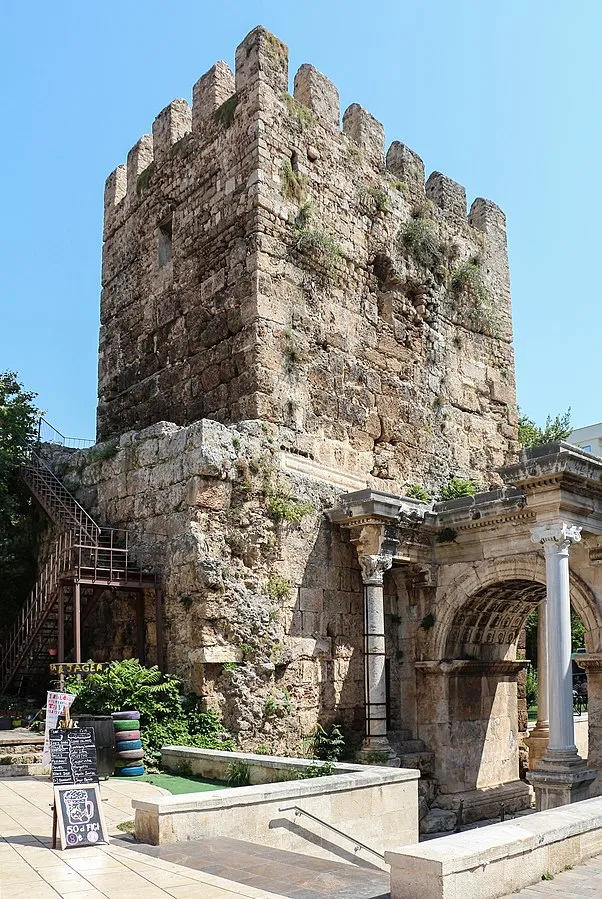
Discover the ancient South Tower of Hadrian's Gate in Antalya, Turkey. Explore its Roman origins, unique architecture, and historical significance.
<h2>Overview</h2><p>Stepping into Antalya's historic Kaleiçi district through Hadrian's Gate offers a captivating journey back in time. This monumental arch, also known locally as Üçkapılar or the 'Three Gates', stands as a proud testament to the city's rich Roman heritage. While the entire gate structure is a marvel, one of its most compelling components is the South Tower, a robust and ancient sentinel guarding the approach to the old city. It's not just a part of the gate; it tells its own story of endurance and architectural evolution, distinct yet integral to the larger narrative of Hadrian's Gate.</p><p>Situated on Atatürk Boulevard, Hadrian's Gate is a prominent landmark, easily accessible and serving as a vibrant threshold between modern Antalya and its past. The South Tower, specifically, catches the eye with its ancient Roman construction, contrasting with the more ornate central arches and its northern counterpart. Its stoic presence invites curious travelers to pause and ponder the millennia of history it has witnessed, a silent guardian of Antalya's heart.</p><h2>History & Cultural Background</h2><p>Hadrian's Gate itself was erected in 130 CE to commemorate the visit of the Roman Emperor Hadrian to the city, then known as Attaleia. This grand gesture underscored the city's importance within the Roman Empire. Initially, the gate was likely incorporated into the defensive walls that encircled the city, effectively becoming a crucial entrance. Over centuries, these surrounding walls eventually obscured the gate, inadvertently protecting it from the ravages of time and the elements. It was only much later, in the 1950s, that the gate was fully rediscovered and restored, revealing its ancient splendor to the modern world.</p><p>The South Tower, often referred to as the Tower of Julia Sancta, predates or was constructed independently of the central gate arches, though it is undeniably Roman in origin. Its architectural style, distinct from the more decorative marble gate, suggests it may have been a pre-existing defensive structure later integrated into the larger triumphal arch complex. A stone inscription found on the tower further confirms its ancient Roman roots. This subtle difference highlights the layered history of the site, where different eras left their indelible marks. In contrast, the northern tower, while having Roman foundations, saw significant reconstruction during the Seljuk period in the 13th century, bearing an Old Turkish inscription in Arabic script.</p><h2>What Makes It Special</h2><p>What makes the South Tower particularly special is its authenticity and its silent narrative of time. Unlike the northern tower which underwent extensive rebuilding, the South Tower largely retains its original Roman-era structure. Made of simple, unadorned block stones, it stands as a stark, powerful reminder of Roman engineering and the functional aspects of ancient city defenses. While the central gate dazzles with its white marble, intricate carvings, floral motifs, and lion head adornments, the South Tower represents raw, enduring strength.</p><p>Its unique history suggests it was likely a standalone defensive element, later adapted to flank the grand triumphal arch. This layered construction illustrates the continuous evolution of Antalya's urban landscape and the pragmatic reuse of existing structures. The presence of a stone inscription, attesting to its antiquity, provides a direct link to the individuals and events of the Roman period, inviting a deeper connection with the past beyond mere observation.</p><h2>Stories, Fun Facts & Local Details</h2><p>Beyond its historical significance, Hadrian's Gate and its towers are steeped in local lore and fascinating details. One popular, albeit unsubstantiated, legend speaks of the Queen of Sheba passing through the gate on her way to visit King Solomon in Aspendos. While historically inaccurate given the gate's construction date, it adds a touch of romantic mystique to the site.</p><p>A more tangible detail, often overlooked, is the deeply grooved stone pavement beneath the central arches. These ruts were carved over centuries by countless cart wheels, testifying to the gate's continuous use as a primary thoroughfare into Attaleia and later, Antalya. Standing by the South Tower, one can almost hear the echoes of merchants, soldiers, and citizens who once passed this very spot. The tower's designation as 'Julia Sancta' also sparks curiosity, though specific details about who Julia Sancta was, remain elusive, contributing to the site's enigmatic charm.</p><h2>Visitor Perspective</h2><p>For the curious traveler, encountering the South Tower is an opportunity for quiet contemplation. Approaching Hadrian's Gate from Atatürk Boulevard, the South Tower is typically on the left, offering a distinct visual contrast to the more rebuilt northern tower on the right. Its robust, ancient stonework invites a tactile connection to history, grounding visitors in the sheer age of the structure. It encourages a closer look, revealing the differences in construction materials and styles that define the gate as a whole.</p><p>As you walk through the triple arches, flanked by these ancient towers, you are not merely observing a monument; you are traversing a portal into Kaleiçi, Antalya's charming old town. The South Tower stands as a gateway not only to physical space but also to a profound historical experience, serving as a powerful introduction to the vibrant tapestry of ancient and modern life that awaits within. It's a place to pause, reflect, and appreciate the enduring legacy of a Roman emperor and the countless lives that have passed through its shadow.</p>
Location
Coordinates: 30.708611, 36.885278
View on Google Maps