Relief “La Marseillaise”
Paris, France

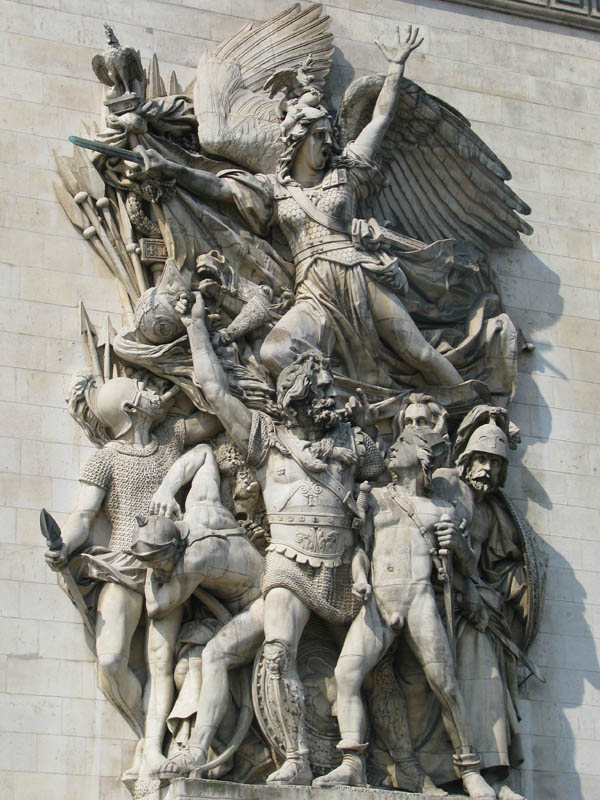
Discover 'La Marseillaise' relief by François Rude at the Arc de Triomphe in Paris, France. Explore its history, symbolism, and cultural significance.
<h2>Overview</h2><p>As you approach the magnificent Arc de Triomphe in Paris, France, your gaze is drawn to its intricately carved facades. Among the four monumental sculptural groups adorning this iconic landmark, one stands out with its dynamic energy and powerful message: the relief known as 'La Marseillaise'. Officially titled 'Le Départ des Volontaires de 1792' (The Departure of the Volunteers of 1792), this high-relief sculpture is an undeniable masterpiece by François Rude. It captures a pivotal moment in French history, depicting citizens enthusiastically joining the fight for their nation, urged on by a winged allegorical figure embodying Liberty and Victory. Positioned on the northeast face of the Arc, facing the famous Champs-Élysées, 'La Marseillaise' is not merely a stone carving; it is a frozen cry of patriotic fervor, inviting viewers to delve into its profound historical and cultural layers.</p><h2>History & Cultural Background</h2><p>The creation of 'La Marseillaise' took place between 1833 and 1836, under the artistic direction of sculptor François Rude. This monumental work was commissioned by King Louis-Philippe, through his minister Adolphe Thiers, during a period of national reconciliation. The Arc de Triomphe itself, conceived by Napoleon in 1806 to celebrate his military triumphs, was still under construction at this time and would be completed in 1836. Rude's specific task was to illustrate the rallying of French citizens in 1792, a critical juncture during the French Revolutionary Wars. In that year, France faced invasion from the First Coalition, primarily Prussia and Austria, seeking to restore the monarchy. The sculpture vividly portrays the passionate response of the French people, volunteering en masse to defend their nascent republic. The allegorical figure leading the volunteers, often synonymous with the spirit of France and its national anthem, wears a Phrygian cap—a potent symbol of freedom derived from the caps worn by freed slaves in ancient Rome. Rude masterfully blended elements of Neoclassicism with the burgeoning Romanticism of his era, creating a work that is both classical in its form and intensely emotional in its execution.</p><h2>What Makes It Special</h2><p>'La Marseillaise' holds a special place not only within the Arc de Triomphe but also in the broader context of French art and national identity. It is widely considered the most renowned of the Arc's four main sculptural groups, commanding attention with its sheer scale and dramatic composition. The colossal dimensions of the figures contribute to its overwhelming impact; for instance, the head of the winged allegorical figure alone measures nearly two meters in height, a detail often hard to fully grasp from ground level. This sculpture is a tour de force of movement and emotion, effectively conveying the urgency and passion of a nation called to arms. The dynamic interplay between the serene yet fierce allegorical figure and the determined, varied expressions of the human volunteers creates a powerful narrative. It’s an enduring symbol of national unity, sacrifice, and the enduring spirit of the French people in defense of their ideals.</p><h2>Stories, Fun Facts & Local Details</h2><p>Behind the powerful imagery of 'La Marseillaise' lie some fascinating details. A well-known story suggests that the striking face of the winged allegorical figure, with its open mouth seemingly mid-cry, was modeled after Sophie Rude, the sculptor's own wife. This personal connection adds another layer of intimacy to the monumental work. Historically, the relief's powerful message transcended its original context. During World War I, 'La Marseillaise' was actively used as a propaganda tool, serving to recruit soldiers and encourage citizens to invest in war bonds, demonstrating its lasting evocative power. The sculpture’s resilience is also noteworthy; it withstood the bombardments during the Siege of Paris in 1870, a testament to its symbolic importance as a republican icon. While primarily known as 'La Marseillaise', the sculpture is sometimes also referred to by the evocative title 'Le Chant du Départ' (The Song of Departure), further linking it to the revolutionary spirit and musical anthem of France. Observers might notice the classical influence in the aged warrior at the center of the group, depicted with flowing hair and Roman armor, leading a younger soldier – an idealized image that served to inspire the 'Gallic warrior' archetype.</p><h2>Visitor Perspective</h2><p>Visiting 'La Marseillaise' is an integral part of the experience of exploring the Arc de Triomphe, a national symbol located at the heart of the Place Charles de Gaulle, at the western end of the Champs-Élysées. As you stand beneath this grand arch, take a moment to truly appreciate the intricate details and emotional depth of Rude's masterpiece. While the sculpture's colossal scale makes it somewhat challenging to fully discern from a distance, its powerful presence is undeniable. The Arc de Triomphe is open daily, inviting travelers to not only admire its exterior reliefs but also to ascend to its panoramic terrace. From the summit, you can enjoy breathtaking 360-degree views of Paris, making the visit a truly memorable experience. This allows for a different perspective of the surrounding cityscape that 'La Marseillaise' proudly overlooks.</p>
Location
Coordinates: 2.295, 48.8738
View on Google Maps