Monet’s “Blue Water Lilies”
Paris, France

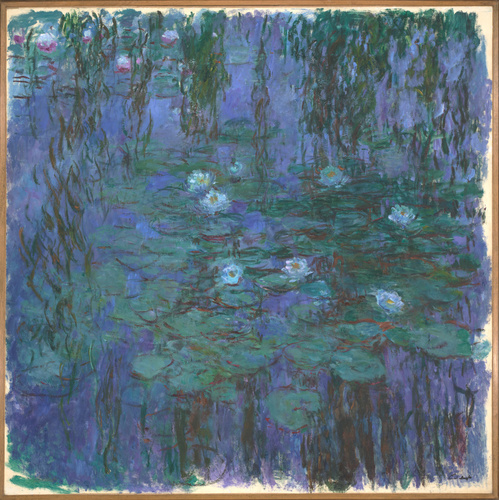
Discover Monet's 'Blue Water Lilies' at the Musée d'Orsay in Paris, France. Explore the history, unique techniques, and stories behind this iconic Impressionist masterpiece.
<h2>Overview</h2><p>Claude Monet's 'Blue Water Lilies' (original French title: 'Nymphéas bleus') is a captivating oil on canvas painting housed within the renowned Musée d'Orsay in Paris, France. Created between 1916 and 1919, this significant artwork measures 200 x 200 cm, presenting a perfect square format that deeply immerses the viewer. It stands as a pivotal piece within Monet's iconic 'Water Lilies' series, a collection that consumed his artistic focus for the later decades of his life. Unlike many landscape paintings, 'Blue Water Lilies' eliminates the traditional horizon and sky, drawing the gaze exclusively to a close-up depiction of the pond's surface, its reflections, and the intricate life within its depths. This approach invites contemplation, offering a profound sense of limitless space and tranquility to those who encounter it.</p><h2>History & Cultural Background</h2><p>Claude Monet (1840-1926) was not only a pioneer but also an enduring force within the Impressionist movement. His revolutionary approach to capturing light and atmosphere transformed European art. The 'Water Lilies' series, including 'Blue Water Lilies', became his singular obsession and primary source of inspiration from the 1910s until his passing in 1926. The genesis of these celebrated works lies in his deeply personal water garden at Giverny, which he meticulously designed and installed in 1893. During the period of this painting's creation, France was embroiled in World War I. Despite the turmoil, Monet, then in his seventies, found solace and a sense of patriotic duty in his continuous artistic endeavor, channeling his energy into these serene pondscapes. Historical accounts suggest his dedication to painting was a form of contribution to the national spirit. Interestingly, Monet's vision was impacted by cataracts later in life, which some art historians believe led to a warmer, more reddish palette in some of his works. However, after successful surgery, his later paintings, including 'Blue Water Lilies', often reflect a return to bluer tones, highlighting the natural beauty he perceived.</p><h2>What Makes It Special</h2><p>'Blue Water Lilies' is distinctive for several reasons that set it apart within Monet's vast oeuvre and art history. By deliberately omitting the horizon line and sky, Monet forces the viewer to confront the water's surface as a complete universe. This artistic choice, combined with the painting's square format, enhances a feeling of neutrality and boundless depth. The brushwork is remarkably free and expressive, often detaching from explicit representational forms. Close inspection reveals strokes that are almost abstract, compelling the viewer's eye and mind to actively construct the implied landscape. This fluidity in execution was so forward-thinking that it is recognized for influencing post-World War II artistic movements, particularly those exploring 'abstract landscapes' and 'lyrical abstraction'. Furthermore, the title 'Blue Water Lilies' refers to the painting's overall dominant blue coloration rather than strictly the hue of the flowers themselves, which were naturally white and pink in Monet's garden but rendered with a profound blue quality in this particular work, reflecting his artistic interpretation and potentially his visual perception.</p><h2>Stories, Fun Facts & Local Details</h2><p>Monet's deep connection to his garden was legendary. He famously declared, 'Apart from painting and gardening, I am good for nothing. My greatest masterpiece is my garden.' This sentiment underscores the profound personal significance of his Giverny sanctuary, which became the exclusive subject of his artistic endeavors for nearly three decades. Another touching anecdote reveals the high esteem in which he was held: upon his death, his close friend, former Prime Minister Georges Clemenceau, famously removed the black cloth draped over Monet's coffin, proclaiming, 'No black for Monet!' and replaced it with a flower-patterned fabric, a fitting tribute to the painter of light and nature. The Musée d'Orsay itself adds a layer of fascinating history to the experience. This grand institution, where 'Blue Water Lilies' resides, was originally the Gare d'Orsay, a magnificent Beaux-Arts railway station built for the 1900 Universal Exhibition. Its transformation into a world-class museum of Impressionist and Post-Impressionist art in 1986 makes the setting as historically rich as the artworks it houses.</p><h2>Visitor Perspective</h2><p>A visit to the Musée d'Orsay offers an unparalleled opportunity to delve into the world of Claude Monet and his contemporaries. Encountering 'Blue Water Lilies' within this grand former railway station is an immersive experience. The museum's curation allows for a unique journey through Monet's artistic evolution, and this particular painting, often located in room 34, invites visitors to linger and appreciate the intricate textures and the evocative composition up close. The sheer scale of the painting, combined with its subject matter, creates a contemplative space, transporting viewers from the bustling heart of Paris to the serene tranquility of Monet's Giverny pond. Observing the brushwork allows one to appreciate the artist's innovative technique, where individual strokes coalesce into a breathtaking visual symphony. The Musée d'Orsay not only presents an artistic masterpiece but also frames it within a historical and architectural marvel, enriching the visitor's understanding and appreciation of this iconic work of art.</p>
Location
Coordinates: 2.326561, 48.859962
View on Google Maps