Model of the Grand Mosque and Kaaba
Mecca, Saudi Arabia

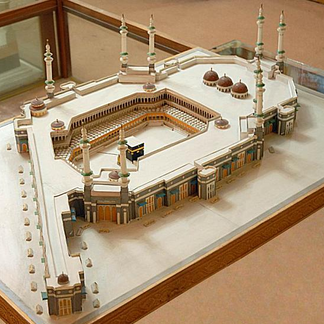
Explore the detailed Model of the Grand Mosque and Kaaba at the Makkah Museum in Mecca, Saudi Arabia, revealing centuries of Islamic architecture and history.
<h2>Overview</h2><p>Deep within the revered city of Mecca, Saudi Arabia, lies a cultural treasure known as the Exhibition of the Two Holy Mosques Architecture, often referred to as the Makkah Museum or Haramain Museum. This significant institution is dedicated to preserving and showcasing the rich history and architectural evolution of Islam's two holiest sites: the Grand Mosque (Masjid al-Haram) in Mecca and the Prophet's Mosque (Masjid an-Nabawi) in Medina. Among its most compelling displays is a meticulously crafted model of the Grand Mosque and the Kaaba, offering visitors an unparalleled opportunity to grasp the scale, design, and spiritual essence of these sacred structures.</p><p>Established in February 2000, the museum serves as a vital educational and cultural landmark. It spans approximately 1,200 square meters, housing a vast collection of artifacts, manuscripts, and photographic archives that trace over 1,400 years of Islamic architectural heritage. Located in the Umm al-Joud area, near the historic Kiswa factory, the museum's design itself harmonizes with classic Islamic architectural styles, echoing the grandeur of the Grand Mosque.</p><h2>History & Cultural Background</h2><p>The history of the Grand Mosque and the Kaaba is intrinsically linked to the very origins of Islam. For centuries, these sites have been central to the Muslim faith, undergoing numerous expansions and renovations to accommodate the ever-increasing number of pilgrims performing Hajj and Umrah. The Exhibition of the Two Holy Mosques Architecture was conceived to document this continuous development and to provide a comprehensive historical narrative.</p><p>The museum's collection features items that span various Islamic eras, from early Islamic periods to the significant expansions witnessed during the Saudi era. This historical journey is meticulously presented through different halls, each dedicated to specific aspects of the mosques' development. The model of the Grand Mosque and Kaaba acts as a centerpiece, illustrating the architectural changes and additions over time, allowing visitors to visualize the intricate details and vastness of the sacred premises.</p><h2>What Makes It Special</h2><p>The model of the Grand Mosque and Kaaba stands out as a particularly special exhibit due to its remarkable detail and the unique perspective it offers. It provides a bird's-eye view of the entire Haram complex, including the Kaaba, the surrounding courtyards, and the intricate minarets and domes, all in a scale that aids comprehension. For many, especially those who may not have had the chance to visit the actual site, or for those seeking a deeper architectural understanding, the model serves as an invaluable educational tool.</p><p>Beyond its visual appeal, the model helps visitors appreciate the engineering marvels and artistic devotion involved in the construction and expansion of these holy sites. It allows for a grasp of the spatial relationship between the Kaaba and the Grand Mosque, providing context to the rituals performed during pilgrimage. This detailed representation ensures that the architectural legacy of the Two Holy Mosques is accessible and understandable to a global audience.</p><h2>Stories, Fun Facts & Local Details</h2><p>Visiting the model offers more than just a visual experience; it’s an invitation to connect with the living history of Islam. Imagine standing before the model, contemplating the millions of pilgrims who have circumambulated the Kaaba throughout history, a ritual faithfully represented by the model's miniature scale. Fun fact: The museum also houses actual historical components of the Kaaba, such as an ancient wooden pillar dating back to the era of Abdullah ibn al-Zubayr, and one of the old Kaaba doors.</p><p>These real artifacts, displayed alongside the comprehensive model, create a powerful link between the past and the present. Visitors can observe the evolution of the Kiswa, the black cloth that drapes the Kaaba, through historical examples and descriptions. The museum’s location near the Kiswa factory adds another layer of local context, allowing a deeper appreciation for the craftsmanship involved in preparing this sacred covering.</p><h2>Visitor Perspective</h2><p>For pilgrims, scholars, and curious travelers alike, the model of the Grand Mosque and Kaaba within the Exhibition of the Two Holy Mosques Architecture is a profoundly moving and enlightening experience. It offers a moment of quiet reflection, allowing one to absorb the spiritual significance and architectural grandeur of these holy sites without the crowds and bustle of the actual Grand Mosque. The meticulous displays, enhanced by modern exhibition techniques and sophisticated lighting, ensure an immersive and engaging visit.</p><p>The museum's staff, often comprising knowledgeable Saudi youth, provide comprehensive educational services, enriching the visitor's understanding of each exhibit. The model, in particular, often evokes a sense of awe and a deeper appreciation for the sacred geography of Mecca. It transforms an abstract concept into a tangible reality, fostering a stronger connection to Islamic heritage and the timeless traditions centered around the Kaaba. It truly is a journey through architectural evolution and spiritual devotion.</p>
Location
Coordinates: 39.82563, 21.42664
View on Google Maps