Mihrab & Minbar
Istanbul, Turkey

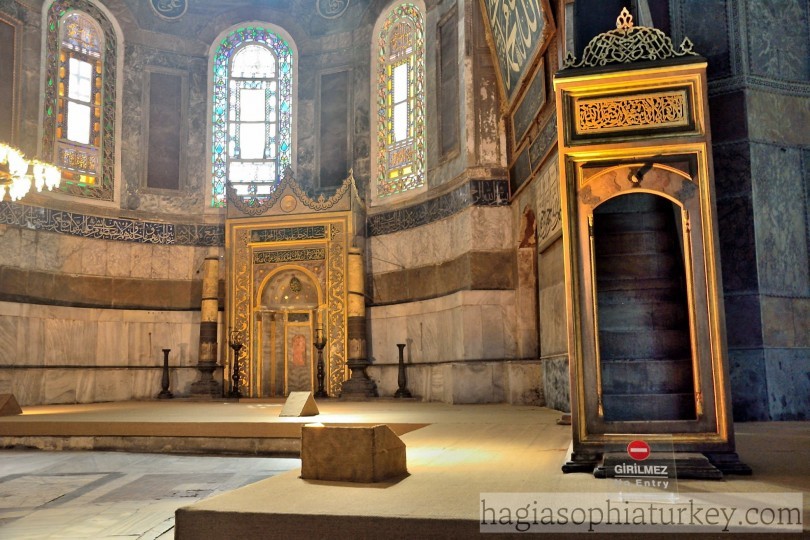
Discover the Mihrab and Minbar within Istanbul's Hagia Sophia, exploring their history, cultural significance, and unique architectural details in Turkey.
<h2>Overview</h2><p>Stepping into Istanbul's magnificent Hagia Sophia, a monument that has stood for centuries as a testament to shifting empires and beliefs, visitors will discover the profoundly significant elements of the Mihrab and Minbar. These sacred components, added after the building's conversion from a Byzantine cathedral to an Ottoman mosque, represent a pivotal shift in its spiritual identity. The Mihrab, a beautifully adorned niche, points devout worshippers toward the holy city of Mecca, serving as the focal point for prayer. Adjacent to it, the elegant Minbar, a raised pulpit, is where the imam delivers sermons, guiding the congregation. Together, these features are not mere architectural additions; they are powerful symbols of Hagia Sophia's layered history, inviting contemplation on its enduring legacy as a place of profound devotion and cultural synthesis.</p><h2>History & Cultural Background</h2><p>Hagia Sophia, originally consecrated as a Christian basilica in 537 CE, served as the patriarchal cathedral of Constantinople for over nine centuries. Its architectural grandeur was unmatched, famously featuring a colossal dome. In 1453, with the Ottoman conquest of Constantinople, Sultan Mehmed II ordered its conversion into a mosque. This transformation ushered in new architectural and decorative elements, including the Mihrab and Minbar, to adapt the space for Islamic worship. The Mihrab, a semicircular niche, was meticulously crafted and placed within the apse, indicating the Qibla, the direction of prayer towards Mecca. Its position was slightly off-center from the original apse to achieve precise alignment with Mecca. Later, the elaborately carved Minbar was introduced under Sultan Murad III in the late 16th century, providing the pulpit from which the Friday sermon (khutbah) is delivered. These additions were thoughtfully integrated, ensuring harmony with the existing Byzantine structure, rather than defacing its older layers.</p><h2>What Makes It Special</h2><p>The Mihrab and Minbar in Hagia Sophia are exceptional for several compelling reasons. The Mihrab, fashioned from finely veined marble and inset with gilded calligraphy of Quranic verses, stands out as a masterpiece of Ottoman artistry. It is flanked by two impressive bronze candlesticks, historically brought from Buda during Suleyman the Magnificent's Hungarian campaign, adding to its unique splendor. Sultan Murad III further enhanced the Mihrab by adding two ancient marble cubes from Bergama, dating back to 4 B.C., a subtle nod to antiquity within this sacred space. Above it, delicate stained glass from the reign of Sultan Abdülmecid filters sunlight, illuminating the apse with a soft, ethereal glow. The Minbar, completed later in the 16th century, is an exquisite example of Ottoman refinement. Made of white marble, its sculpted panels feature intricate arabesque patterns, and it is crowned with a slender spire. What truly distinguishes these elements is their harmonious coexistence with the building's Christian past. They represent a dialogue between faiths, a seamless integration that transformed the space's spiritual function without erasing its rich historical tapestry.</p><h2>Stories, Fun Facts & Local Details</h2><p>One fascinating aspect of Hagia Sophia's conversion is the care taken to align the new Islamic elements. The Mihrab's slight off-center placement from the original Byzantine apse is a result of precise astronomical calculations to correctly face Mecca, demonstrating the technical and spiritual considerations involved. Imagine the skill required to integrate these grand structures into a building not originally designed for them, yet achieving such profound aesthetic and functional cohesion. The Minbar's stairway, often used by the imam during Friday prayers, symbolizes a physical and spiritual ascent, reflecting a key principle in Islamic art and devotion. The very act of Fatih Sultan Mehmed Khan ordering the preservation of the sanctity of Hagia Sophia upon its conversion, while redirecting its purpose, speaks volumes about the reverence accorded to this magnificent edifice across different eras. The Mihrab and Minbar therefore don't just stand as religious artifacts; they are storytellers of Istanbul's multifaceted history, whispering tales of emperors, sultans, and countless prayers spanning over a millennium and a half.</p><h2>Visitor Perspective</h2><p>For any traveler exploring Hagia Sophia in Istanbul, a moment spent contemplating the Mihrab and Minbar is essential. Approaching the Mihrab from the central nave, one can appreciate how it draws the eye towards the dome's distant light, creating a powerful sense of direction and purpose. Observing the intricate details of the carved marble and gilded calligraphy, and then turning to the elegant Minbar, offers a tangible connection to the building's evolution. It's a chance to witness how architectural mastery can accommodate profound spiritual shifts, creating a space where both Byzantine and Ottoman legacies are honored and felt. These elements provide a quiet culmination of everything the Hagia Sophia has become, a deeply moving experience for any curious visitor.</p>
Location
Coordinates: 28.980261, 41.008469
View on Google Maps