Deesis Mosaic
Istanbul, Turkey

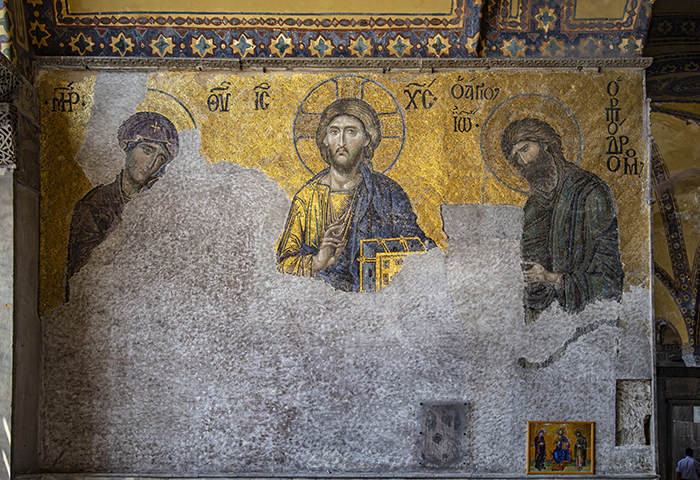
Discover the Deesis Mosaic in Hagia Sophia, Istanbul, Turkey. This 13th-century Byzantine masterpiece portrays Christ, Mary, and John the Baptist with stunning realism and emotional depth.
<h2>Overview</h2><p>Stepping into the magnificent Hagia Sophia in Istanbul, Turkey, one's gaze is invariably drawn upwards, towards the shimmering mosaics that adorn its vast interior. Among these, the Deesis Mosaic stands as a profound masterpiece, captivating visitors with its emotional depth and artistic brilliance. Located within the South Gallery, this breathtaking 13th-century Byzantine artwork depicts a powerful scene: Jesus Christ Pantocrator at its center, flanked by the Virgin Mary and Saint John the Baptist. The term 'Deesis' itself, derived from the Greek word for 'entreaty' or 'supplication,' beautifully encapsulates the mosaic's theme. Mary and John are shown in postures of profound appeal, interceding on behalf of humanity before Christ, the Universal Ruler. It is considered one of the finest examples of Byzantine mosaic art, a testament to the era's sophisticated craftsmanship and spiritual fervor.</p><h2>History & Cultural Background</h2><p>The Deesis Mosaic dates back to a pivotal moment in Byzantine history, around 1261 AD. This was the period following the Byzantines' reclamation of Constantinople from the Latin Crusaders, who had occupied the city from 1204. The return of Byzantine rule ushered in a period often referred to as the 'Palaeologan Renaissance,' a cultural and artistic revival aimed at restoring the empire's former glory. Emperor Michael VIII Palaiologos, who led the reconquest, is widely believed to have commissioned the mosaic as part of a broader restoration effort within Hagia Sophia, transforming it back into an Orthodox cathedral. Its creation was a powerful statement of renewed Orthodox identity and faith after years of Latin dominance.</p><p>Centuries later, with the Ottoman conquest of Constantinople in 1453, Hagia Sophia was converted into a mosque. As Islamic tradition generally prohibits figural representations, many of the Christian mosaics were covered with plaster. Fortunately, they were not destroyed, effectively preserving them for future generations. The Deesis Mosaic remained hidden until the 20th century. Between 1934 and 1938, under the leadership of Thomas Whittemore and the Byzantine Institute of America, extensive restoration work began to uncover and conserve these hidden treasures. It was during this period that the world once again saw the profound beauty of the Deesis.</p><h2>What Makes It Special</h2><p>What truly sets the Deesis Mosaic apart is its remarkable artistic style. It represents a significant departure from the more rigid and symbolic forms of earlier Byzantine art, showcasing a striking realism and profound emotional depth. The faces of Christ, Mary, and John the Baptist are rendered with naturalistic expressions, subtle shading, and delicate contrasts, which imbue them with an almost lifelike quality. This advanced technique, employing incredibly fine tesserae—some reportedly as small as a pinhead—allowed the mosaicists to achieve a level of detail and humanism rarely seen in Byzantine works. Many art historians consider this naturalism a precursor to the Italian Renaissance, highlighting its groundbreaking nature.</p><p>The strategic placement of the mosaic in the South Gallery, a section traditionally reserved for the imperial family and court, underscores its importance. The gold backgrounds, typical of Byzantine mosaics, were meticulously crafted to catch and reflect light from nearby windows and candles, creating a shimmering, ethereal effect that gave the figures a sense of movement and divine presence. This interplay of light and intricate detail elevates the Deesis Mosaic beyond mere decoration, making it a powerful visual experience.</p><h2>Stories, Fun Facts & Local Details</h2><ul><li>The term 'Deesis' itself is a powerful concept in Orthodox Christianity, signifying the plea for mercy and intercession for humanity, a theme vividly conveyed by the figures' expressions and gestures.</li><li>The figures in the mosaic are monumental in scale, approximately two and a half times larger than life, enhancing their impact and presence within the vastness of Hagia Sophia.</li><li>While Christ's face remains remarkably well-preserved, portions of the Virgin Mary's figure have suffered damage over the centuries, likely due to its proximity to open windows.</li><li>A fascinating anecdote from its rediscovery relates that before Thomas Whittemore's team began their meticulous work, some workers, unaware of the mosaic's value, accidentally damaged part of John the Baptist's figure during preliminary explorations.</li><li>The masterful technique of angling individual tesserae to manipulate light reflection was an ingenious method, making the mosaic appear to sparkle and move as viewers changed their perspective, almost bringing the sacred figures to life.</li></ul><h2>Visitor Perspective</h2><p>Today, visiting the Deesis Mosaic is an essential part of exploring Hagia Sophia. As a traveler, approaching the South Gallery, you'll feel the atmosphere shift, preparing you for the solemn encounter with this masterpiece. Its grandeur and the palpable emotion conveyed by the figures invite a moment of quiet contemplation, regardless of your personal beliefs. The surviving upper portions of the mosaic, especially the penetrating gaze of Christ, are incredibly moving and connect visitors across centuries to the spiritual and artistic aspirations of the Byzantine Empire. Observing the meticulous detail of the tiny tesserae up close offers a profound appreciation for the skill of the artisans. The Deesis Mosaic is not merely a historical artifact; it is a timeless piece of art that continues to resonate, offering a deep insight into the cultural and spiritual legacy of Istanbul.</p>
Location
Coordinates: 28.980261, 41.008469
View on Google Maps