Cave of Hira
Mecca, Saudi Arabia

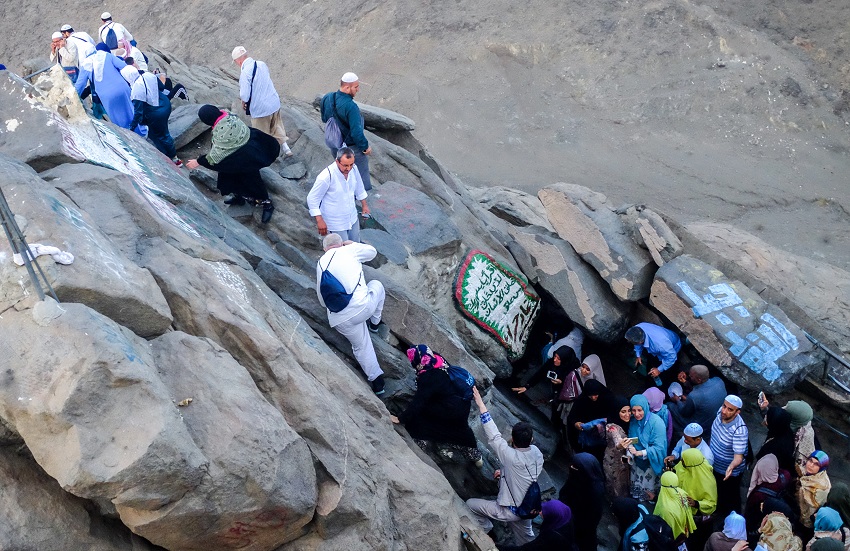
Explore the Cave of Hira in Mecca, Saudi Arabia, the sacred site on Jabal al-Nour where Prophet Muhammad received the first Quranic revelations.
<h2>Overview</h2><p>Nestled within the rugged peaks of Jabal al-Nour, or the 'Mountain of Light', in Mecca, Saudi Arabia, lies the revered Cave of Hira. This unassuming cave holds immense spiritual significance for Muslims worldwide, serving as the sacred site where Prophet Muhammad (peace be upon him) received the first revelations of the Holy Quran. It is a place of profound historical and cultural importance, drawing pilgrims and curious travelers seeking to connect with the origins of Islam.</p><p>Jabal al-Nour stands approximately 4 kilometers (2.5 miles) northeast of the Kaaba in Mecca, rising to an elevation of around 642 meters (2,106 feet) above sea level. The Cave of Hira itself is a small, narrow opening near the summit of this mountain, offering a modest space that can accommodate only a few individuals at a time. Its simple appearance belies the monumental events that unfolded within its confines, forever shaping human history.</p><h2>History & Cultural Background</h2><p>Before his prophethood, Muhammad (peace be upon him) often sought solitude and reflection, retreating to the Cave of Hira for meditation and contemplation. This practice, known as 'tahannuth', involved spending days and nights in seclusion, distancing himself from the societal distractions and moral complexities of pre-Islamic Mecca. He would take provisions with him and often feed the poor who came seeking him.</p><p>It was during one of these retreats, in the month of Ramadan in 610 CE, when Prophet Muhammad was 40 years old, that Angel Gabriel appeared to him in the cave. This divine encounter marked the beginning of his prophetic mission and the initial revelation of the Holy Quran. Angel Gabriel commanded him to 'Read!', a command that profoundly impacted the Prophet, leading to the revelation of the first verses of Surah Al-Alaq: 'Read in the name of your Lord who created.' This pivotal event, often referred to as 'Laylat al-Qadr' or the 'Night of Power', established the Cave of Hira as the birthplace of Islam's divine message.</p><h2>What Makes It Special</h2><p>The unparalleled significance of the Cave of Hira stems entirely from its role as the starting point of divine revelation in Islam. It is not its physical grandeur, for the cave is quite small—measuring roughly 3.7 meters (12 feet) in length and 1.6 meters (5 feet 3 inches) in width—but rather the monumental spiritual transformation that began there.</p><p>This modest cavity in the mountain served as the conduit through which God's word first reached humanity, transforming Prophet Muhammad from a seeker of truth into a messenger of Allah. The simplicity of the setting underscores a profound lesson: that revelation and spiritual enlightenment often begin in humility, contemplation, and sincere introspection, far removed from worldly power or prominence. Its enduring legacy lies in initiating a faith that would guide billions across centuries.</p><h2>Stories, Fun Facts & Local Details</h2><p>Jabal al-Nour, meaning 'Mountain of Light' or 'Hill of Illumination', gained its name due to the divine light of Prophethood that emerged from its summit. Some describe the mountain's unique shape as resembling a camel's hump.</p><p>Upon receiving the first revelation, Prophet Muhammad (peace be upon him) was deeply affected, trembling and turning pale, and hurried home to his wife Khadijah (may Allah be pleased with her) for comfort. This moment of profound spiritual awe highlights the intensity of the experience.</p><p>At the base of Jabal al-Nour, visitors can now find the Hira Cultural District, a thoughtfully designed area offering exhibitions and museums that aim to bring the story of the first revelation to life through immersive displays and historical artifacts, providing an enriching experience for those unable or unwilling to undertake the climb.</p><h2>Visitor Perspective</h2><p>Visiting the Cave of Hira is a pilgrimage of dedication, requiring a challenging climb up Jabal al-Nour. The ascent involves navigating steep paths and approximately 1,200 to 1,750 steps, taking anywhere from 45 minutes to 3 hours, depending on an individual's physical fitness. Many pilgrims consider this arduous journey an act of devotion, symbolically tracing the footsteps of the Prophet (peace be upon him) and reflecting on his perseverance.</p><p>The best times to undertake the climb are during the cooler parts of the day, such as early morning before sunrise or late afternoon, to avoid the intense heat. Visitors are advised to wear comfortable footwear, carry sufficient water, and approach the site with reverence and mindfulness. While visiting the Cave of Hira is not an obligatory ritual of Hajj or Umrah, it remains a highly cherished 'ziyarat' (visit to a holy place) for many, offering a unique opportunity for spiritual introspection and a deeper connection to Islamic history.</p>
Location
Coordinates: 39.8592, 21.45737
View on Google Maps