Basilica Cistern
Istanbul, Turkey

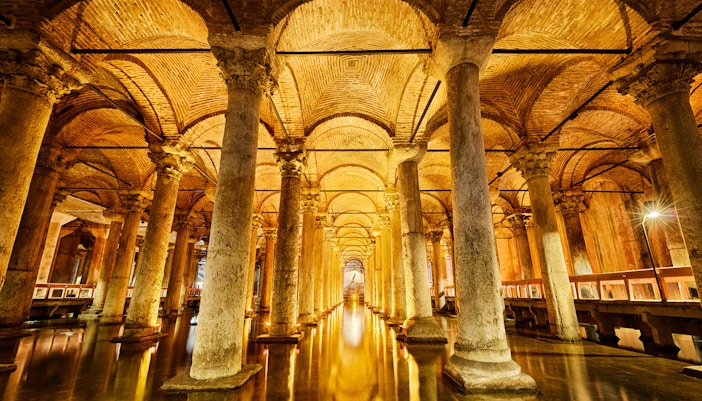
Explore the ancient Basilica Cistern in Istanbul, Turkey, a magnificent 6th-century underground reservoir with 336 columns and mysterious Medusa heads.
<h2>Overview</h2><p>Beneath the bustling streets of Istanbul, Turkey, lies a mesmerizing testament to Byzantine engineering and artistry: the Basilica Cistern. Known locally as 'Yerebatan Sarnıcı' or 'Sunken Palace' due to its grand scale and numerous columns, it is the largest of several hundred ancient cisterns that exist underneath the city. This subterranean marvel, a must-visit for any traveler, offers a unique blend of history, mystery, and architectural splendor. Visitors traverse raised walkways, floating above shallow waters that reflect a forest of 336 marble columns, creating an ethereal and unforgettable atmosphere.</p><p>The Basilica Cistern is approximately 140 meters long and 70 meters wide, covering an area of nearly 10,000 square meters. It once had the capacity to hold up to 80,000 cubic meters of water, playing a crucial role in supplying water to Constantinople's Great Palace and surrounding buildings. Today, it stands as a preserved historical site, drawing millions of visitors annually to explore its cool, dimly lit chambers and unravel its ancient secrets.</p><h2>History & Cultural Background</h2><p>The construction of the Basilica Cistern dates back to the 6th century, commissioned by the Byzantine Emperor Justinian I between 527 and 565 AD. It was built after the Nika riots of 532, which devastated much of Constantinople, as part of a larger rebuilding effort. The cistern's name, 'Basilica,' originates from its location beneath a large public square, the Stoa Basilica, which was a significant commercial, legal, and artistic center during the early Roman Age.</p><p>Historical accounts suggest that up to 7,000 slaves were involved in its colossal construction, a remarkable feat of ancient engineering. The cistern served as a vital water filtration and storage system, supplying the Great Palace of Constantinople and other structures on the First Hill. Even after the Ottoman conquest of Constantinople in 1453, it continued to provide water to the Topkapı Palace for a period.</p><p>Over centuries, the cistern's significance waned, and its existence was largely forgotten by officials, though locals continued to draw water from it through wells in their basements. It was famously rediscovered in 1565 by the French traveler Petrus Gyllius, who documented being rowed through its vast, fish-filled interior. Significant restorations occurred during the Ottoman era and, more extensively, between 1985 and 1987 by the Istanbul Metropolitan Municipality, after which it was opened as a museum in 1987.</p><h2>What Makes It Special</h2><p>What truly sets the Basilica Cistern apart is its extraordinary architectural design and the ingenious reuse of materials. The ceiling is supported by 336 marble columns, each approximately 9 meters high, arranged in 12 rows of 28. Many of these columns were repurposed from older buildings and temples across the Roman Empire, showcasing a mix of Ionic, Corinthian, and Doric styles.</p><p>Among its most captivating features are the two Medusa head bases, positioned in the northwest corner of the cistern. One is placed sideways, and the other inverted, giving rise to various myths and legends. This peculiar positioning is often believed to negate the power of the Gorgon's gaze or to repurpose pagan symbols into a Christian context. Another distinctive column is the 'Weeping Column,' adorned with carvings resembling tears or peacock eyes, believed by some to honor the thousands of enslaved people who died during the cistern's construction. The play of light, shadows, and water reflections within the vast, echoing space creates a uniquely atmospheric experience, often described as eerie yet beautiful.</p><h2>Stories, Fun Facts & Local Details</h2><p>The Basilica Cistern has long been a source of fascination and inspiration, earning its 'Sunken Palace' moniker from the locals due to its grandeur. Its mysterious ambiance has even caught the attention of Hollywood, serving as a dramatic backdrop in films like 'From Russia with Love' and 'Inferno,' a significant boost to its global recognition. Historically, the cistern served various roles, with some legends even suggesting it might have been a place of worship. Archaeological discoveries within its depths have included ancient artifacts, pottery shards, and even Byzantine copper coins, offering glimpses into its long past.</p><p>The cistern's design also incorporates natural phenomena, such as watermarks on the columns indicating historical water levels, which tell a story of droughts and wartime water management. The cool microclimate maintained underground provides a refreshing escape from Istanbul's summer heat. Whispers of hidden tunnels and secret chambers, though not accessible to the public, add another layer of intrigue, with some believing a passage once led directly to the Great Palace.</p><h2>Visitor Perspective</h2><p>Visiting the Basilica Cistern offers an immersive journey into Istanbul's rich history. To fully appreciate its beauty and avoid peak crowds, it is recommended to visit early in the morning or later in the afternoon, especially during the shoulder seasons of spring and fall. While there is no strict dress code, comfortable and modest attire is advised, keeping in mind the cultural and historical significance of the site. Photography is generally allowed, but flash photography is often discouraged to preserve the atmosphere and avoid reflections.</p><p>The duration of a typical visit ranges from 30 minutes to an an hour, allowing ample time to explore the columns, marvel at the Medusa heads, and soak in the tranquil environment. The cistern is located in the Sultanahmet district, making it easily accessible and close to other major landmarks such as the Hagia Sophia and the Blue Mosque, allowing for a comprehensive historical itinerary. The recent comprehensive restorations have further enhanced the visitor experience, solidifying the Basilica Cistern's place as a truly unique and awe-inspiring destination in Istanbul.</p>
Location
Coordinates: 28.977762, 41.008362
View on Google Maps