Anthropocene
Cancún, Mexico

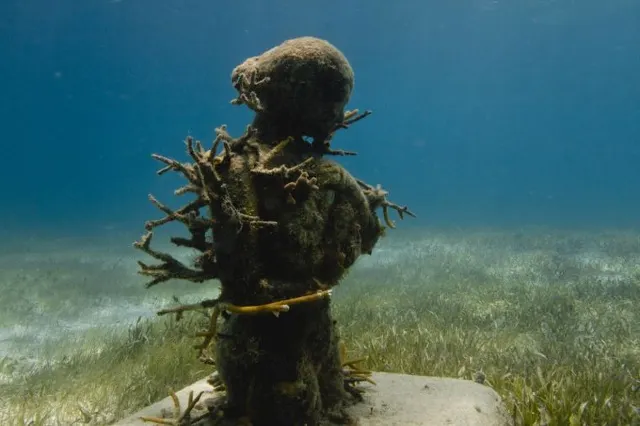
Explore 'Anthropocene' within the Cancun Underwater Museum (MUSA) in Cancún, Mexico. Discover this unique sculpture's role in marine conservation.
<h2>Overview</h2> <p>Deep within the vibrant marine ecosystem off the coast of Cancún, Mexico, lies a unique and thought-provoking artwork named 'Anthropocene'. This specific sculpture is an integral part of the Museo Subacuático de Arte, widely known as MUSA, an ambitious underwater museum that blends contemporary art with crucial marine conservation efforts. MUSA, an acronym for 'Museo Subacuático de Arte', translates to 'Underwater Museum of Art' [11]. It was conceived not just as an artistic spectacle, but as a vital artificial reef designed to divert human impact away from fragile natural coral formations and foster new marine life [2, 3, 10, 16]. 'Anthropocene' stands among more than 500 life-sized sculptures in MUSA's collection, offering visitors a profound reflection on humanity's influence on the natural world, all while serving as a home for aquatic flora and fauna [6, 8, 12, 13].</p> <h2>History & Cultural Background</h2> <p>The genesis of MUSA dates back to 2009, born from a collaborative vision between Jaime Gonzalez Cano, then director of Mexico's National Marine Park, and British sculptor Jason deCaires Taylor [3, 7, 11, 16]. The protected marine areas of Cancún were under immense stress from millions of tourists, leading to significant damage to the natural reefs [2, 3]. To combat this, the idea was to create an alternative attraction that would not only educate visitors about conservation but also provide a new habitat for marine species [2, 16, 17]. The sculptures, including 'Anthropocene', are crafted from a special pH-neutral marine concrete, specifically formulated to encourage coral polyps to attach and grow, effectively transforming art into a living, evolving reef [7, 9, 12, 16]. This innovative approach marries art with environmental science, making MUSA a global pioneer in sustainable tourism and ecological restoration [12].</p> <h2>What Makes It Special</h2> <p>'Anthropocene' is special because it embodies the core philosophy of MUSA: a dynamic interplay between human artistry and natural processes. The term 'Anthropocene' itself refers to the current geological epoch, characterized by significant human impact on Earth's geology and ecosystems. As a submerged sculpture, it silently questions our legacy and responsibility towards the planet [9]. Over time, like all MUSA sculptures, 'Anthropocene' undergoes a remarkable transformation. It's not a static museum piece; instead, it becomes colonized by algae, sponges, and various coral species, slowly changing its appearance and becoming an integral part of the underwater habitat [7, 9, 16]. This continuous evolution means that each visit offers a different visual and ecological experience, highlighting the museum's commitment to creating art that serves a tangible environmental purpose [7, 16].</p> <h2>Stories, Fun Facts & Local Details</h2> <p>Within MUSA, 'Anthropocene' is located in the deeper Salon Manchones gallery, which houses over 470 sculptures and is a popular site for scuba diving [6, 8]. This gallery is also home to other evocative works like 'The Silent Evolution', a collection of nearly 450 life-sized human figures, and 'The Bankers', depicting men with their heads buried in the sand [7, 8]. The sheer scale of MUSA, with over 500 permanent life-size sculptures spread across 420 square meters, makes it one of the largest underwater museums globally [6, 9]. A fascinating aspect is how the collection helps alleviate pressure on the natural reefs by redirecting thousands of visitors to an artificial one, thereby allowing the natural ecosystems a chance to regenerate [9, 16, 17]. The sculptures are designed to be resilient, promoting marine biodiversity and increasing biomass within the area [9, 12, 16]. It's a testament to how creative thinking can address urgent environmental challenges.</p> <h2>Visitor Perspective</h2> <p>Experiencing 'Anthropocene' and the Salon Manchones gallery is primarily an opportunity for certified scuba divers, given its depth of approximately 8 meters (26-33 feet) [5, 6, 8, 10]. While some areas of MUSA are shallow enough for snorkeling or glass-bottom boat tours, the deeper installations offer an immersive perspective that only diving can provide [5, 6, 7, 10, 11]. Descending into the clear Caribbean waters to witness these sculptures evokes a unique sense of wonder and reflection [9, 21]. The silence underwater, broken only by the sound of your own breath, amplifies the visual impact of 'Anthropocene' and its companions, creating an almost surreal encounter between art and the ocean [9]. Visitors often describe a profound connection to the conservation message, seeing firsthand how art can be a catalyst for ecological change and a haven for marine life [8, 9]. It's an unforgettable journey that combines adventure with a powerful environmental narrative.</p>
Location
Coordinates: -86.732778, 21.050556
View on Google Maps